
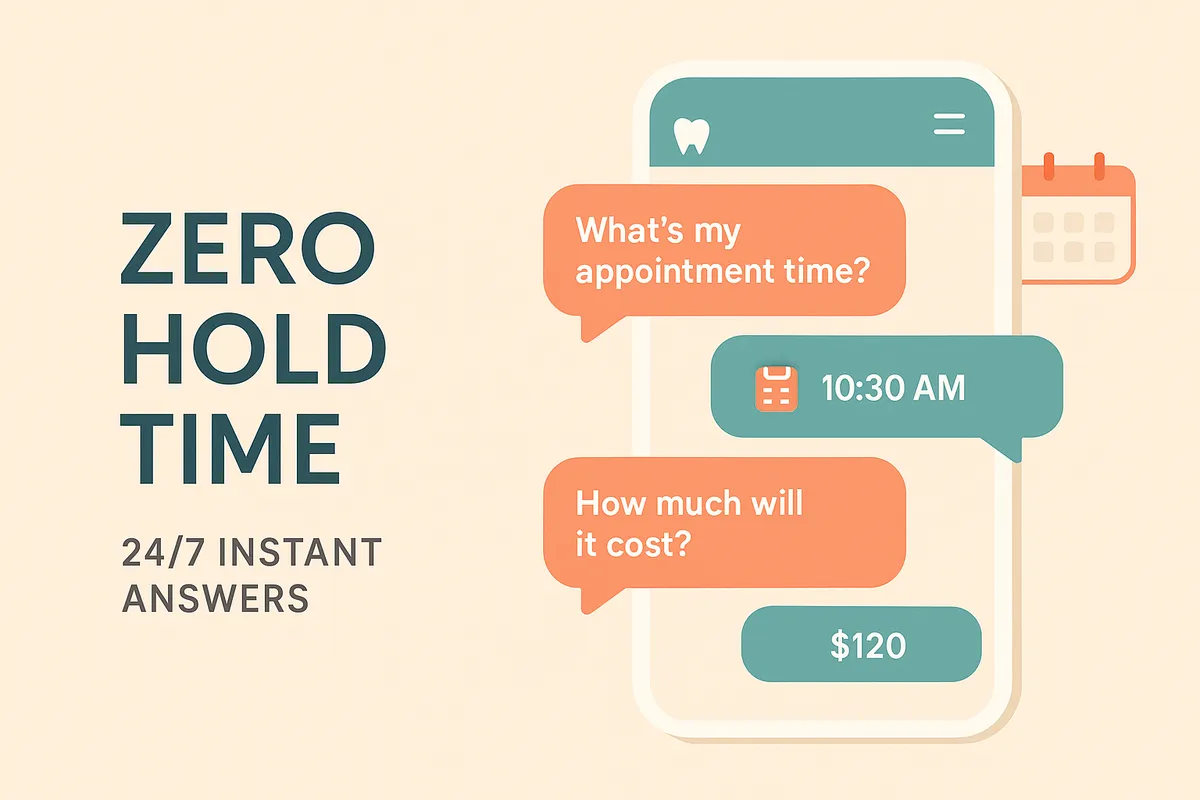
Patient expectations for dental practices have been quietly transforming for years — and the pandemic accelerated that shift dramatically. Patients who learned to accomplish everything from banking to grocery shopping in seconds on their phones now carry those expectations into every service interaction, including healthcare.
The dental practice that meets those expectations wins. The one that doesn’t loses patients to competitors who do — often without ever understanding why those patients left.
Here’s what the data and patient behavior actually show about what dental patients want in 2025.
Speed: The First Filter
Before a patient evaluates your clinical skills, your location, or your pricing, they evaluate your responsiveness. How quickly did you answer? How fast did they get a booking confirmation?
Speed functions as a proxy for professionalism and competence. A practice that answers instantly projects competence. A practice that goes to voicemail or takes 24 hours to respond to an email inquiry projects disorganization — even if the clinical work is excellent.
The Data on Response Time
Research from Harvard Business Review found that response time to initial inquiries dramatically affects conversion: companies that respond within 5 minutes are 100x more likely to connect with a lead than those that respond within 30 minutes. Dental practices follow the same pattern.
When a patient calls about a new appointment and reaches a person or AI that answers immediately, the call almost always ends with a booking. When they reach voicemail, 80% don’t leave a message and most don’t call back.
What Speed Looks Like in Practice
- A call answered in under 1 second vs. a phone that rings 4-5 times before voicemail
- An appointment confirmed during the call vs. “we’ll call you back to confirm”
- A question answered immediately vs. “let me check and get back to you”
Every one of these interactions signals whether a practice respects the patient’s time. The fastest practices in a market have an inherent patient acquisition advantage that has nothing to do with their clinical skills.
Clarity: The Trust Builder
Speed gets patients on the phone. Clarity is what converts the conversation into a booked appointment and a trusting patient relationship.
Dental patients frequently arrive at an interaction with anxiety — about procedures, about cost, about what to expect. The practices that address that anxiety directly with clear, specific answers retain patients at dramatically higher rates than those who respond vaguely or redirect to “the doctor will discuss that at your appointment.”
What Patients Actually Want Clarity On
Based on the most common questions that come through dental answering services, patients most often want to know:
- Insurance and cost: Do you take my insurance? What will I owe out of pocket? — Vague answers (“it depends”) create anxiety. Specific answers (“we accept Delta Dental PPO, and for a new patient cleaning, patients typically pay $X after insurance”) build trust.
- What to expect: What happens at a first appointment? How long will this procedure take? Will this hurt? — Patients who know what to expect show up less anxious and cancel less often.
- Appointment logistics: Where are you located? Where do I park? What do I need to bring? — Small friction points at this stage cause no-shows. Clear pre-visit information reduces them.
- Provider information: Who will I be seeing? What’s their background? — Patients considering high-value treatment want to know who they’re trusting.
The Consistency Problem
Clarity also means consistency. A patient who calls twice and gets different answers from two different staff members loses confidence in the practice. An AI system configured with your practice’s approved answers delivers identical, accurate responses every time — no matter who answers or when.
Zero Hold Time: The Modern Dealbreaker
Hold time is one of the fastest ways to lose a patient you’ve already reached.
Being put on hold signals that the practice’s internal operations are more important than the patient’s time. It creates frustration before the conversation even begins. And for patients calling about elective procedures — who aren’t facing an urgent need and are evaluating multiple options — being put on hold is often the moment they decide to hang up and call the next practice on their list.
How This Has Changed
Patients who are used to instant messaging, same-day delivery, and on-demand streaming have recalibrated their tolerance for waiting. Hold times that felt acceptable five years ago feel unacceptable now.
A 2-minute hold in a world of instant everything is a meaningful friction point. It says: you’re not our priority right now.
The Solution Isn’t More Staff
The instinctive response to hold time problems is to add front desk staff. But staff additions are expensive, the hiring market for dental front desk roles is difficult, and the hold time problem tends to cluster at specific peak periods — adding a full-time hire to cover the 11 AM Thursday rush isn’t economically rational.
The better solution is overflow handling that activates when your team is already on a call or with a patient. GetHelpdesk.AI answers simultaneously — there’s no queue, no hold music, no waiting. Patients who would have been put on hold get an immediate answer instead.
The After-Hours Expectation
Patient behavior has shifted significantly on timing. Patients increasingly research and contact dental practices outside of traditional business hours — evenings, weekends, and closed days account for a growing share of new patient inquiries.
The practice that’s only reachable from 9-5 Monday through Friday is reachable for a minority of the moments when patients actually try to connect.
After-hours coverage used to mean hiring an answering service to take messages. Now it means AI that answers, has a full conversation, and books the appointment — so the patient wakes up with a confirmation and the practice wakes up with a filled schedule.
Language: The Overlooked Preference
For practices in diverse markets, language is a fundamental patient preference that many practices fail to address.
A patient more comfortable in Spanish who calls a dental practice and has to navigate English-language communication has a worse experience from the first moment. They may not understand all the information they receive. They may feel underserved even if the clinical care is excellent.
AI answering that automatically detects and responds in the patient’s language — without needing to press a button or wait for a transfer — addresses this completely. For practices in markets with significant non-English-speaking patient populations, this alone can meaningfully change new patient acquisition.
How GetHelpdesk.AI Addresses These Expectations
GetHelpdesk.AI was designed around how dental patients actually behave in 2025:
- Calls answered in under 1 second — no hold, no menu, no wait
- Natural conversation in 25+ languages — auto-detected from the caller
- Accurate, practice-specific answers to common questions — configured for your practice
- Direct appointment booking into your PMS — confirmation before the call ends
- 24/7 availability including after hours, weekends, and closed days
The practices that consistently deliver on what patients want — speed, clarity, no hold time — retain patients longer, generate more referrals, and outcompete on patient experience even when other factors are similar.
Key Takeaways
- Speed is the first filter patients use to evaluate a dental practice — response time directly affects new patient conversion
- Clarity about insurance, cost, and what to expect reduces anxiety, cancellations, and no-shows
- Hold time is increasingly a dealbreaker for patients accustomed to instant digital interactions
- After-hours demand is growing — practices only reachable 9-5 are missing a significant share of inquiry volume
- Language accessibility is a competitive advantage in diverse markets that most practices neglect
- AI answering addresses all five expectations simultaneously without adding staffing cost
Frequently Asked Questions
How much does hold time actually affect patient retention? Research from customer experience studies (applicable across service industries including healthcare) shows that over 60% of customers who experience hold times longer than 2 minutes report negative satisfaction scores. In dental care, where patients have abundant choice among providers, negative first impressions from hold time directly correlate with lower new patient conversion.
Do patients actually prefer AI to human receptionists? Patient preference surveys show that patients primarily care about the outcome — did they get an answer, was it accurate, did they book an appointment — not the medium. When AI delivers a smooth, accurate experience, patient satisfaction is high. The frustration is with voicemail and hold time, not with AI per se.
How do you configure practice-specific answers? GetHelpdesk.AI is configured through an onboarding process where your practice information — insurance accepted, providers and their specialties, common procedure questions, hours, location — is programmed into the system. The AI answers from this configuration, not from generic dental content.
What happens when a patient asks something outside the configured information? The AI handles out-of-scope questions gracefully — acknowledging the question and either directing the patient to call during business hours for specific answers or flagging for a team follow-up. It doesn’t make up information.
Can AI really handle complex insurance questions? AI can handle common insurance questions accurately when configured with your insurance participation information. For complex coverage determination questions (which require real-time insurance lookup), it appropriately sets expectations and routes to your team.
Ready to deliver what patients in 2025 actually expect? Book a 9-minute demo to see GetHelpdesk.AI answer calls the way your patients want to be answered.
Related Posts
10 Signs Your Dental Practice Needs an AI Answering Service
Not sure if AI answering is right for your practice? These 10 signals — from missed calls to Monday morning voicemail backlogs — tell you the answer.
AI 101 for Dentists: A Plain-Language Guide to What It Is and What It Does
Artificial intelligence sounds complicated until you see what it actually does at a dental practice. This guide explains the concepts that matter — and skips the ones that don't.
AI Answering Service for Dental Practices: The Complete Guide
Everything dental practice owners need to know about AI answering services — how they work, what they cost, what to look for, and how they compare to traditional solutions.