
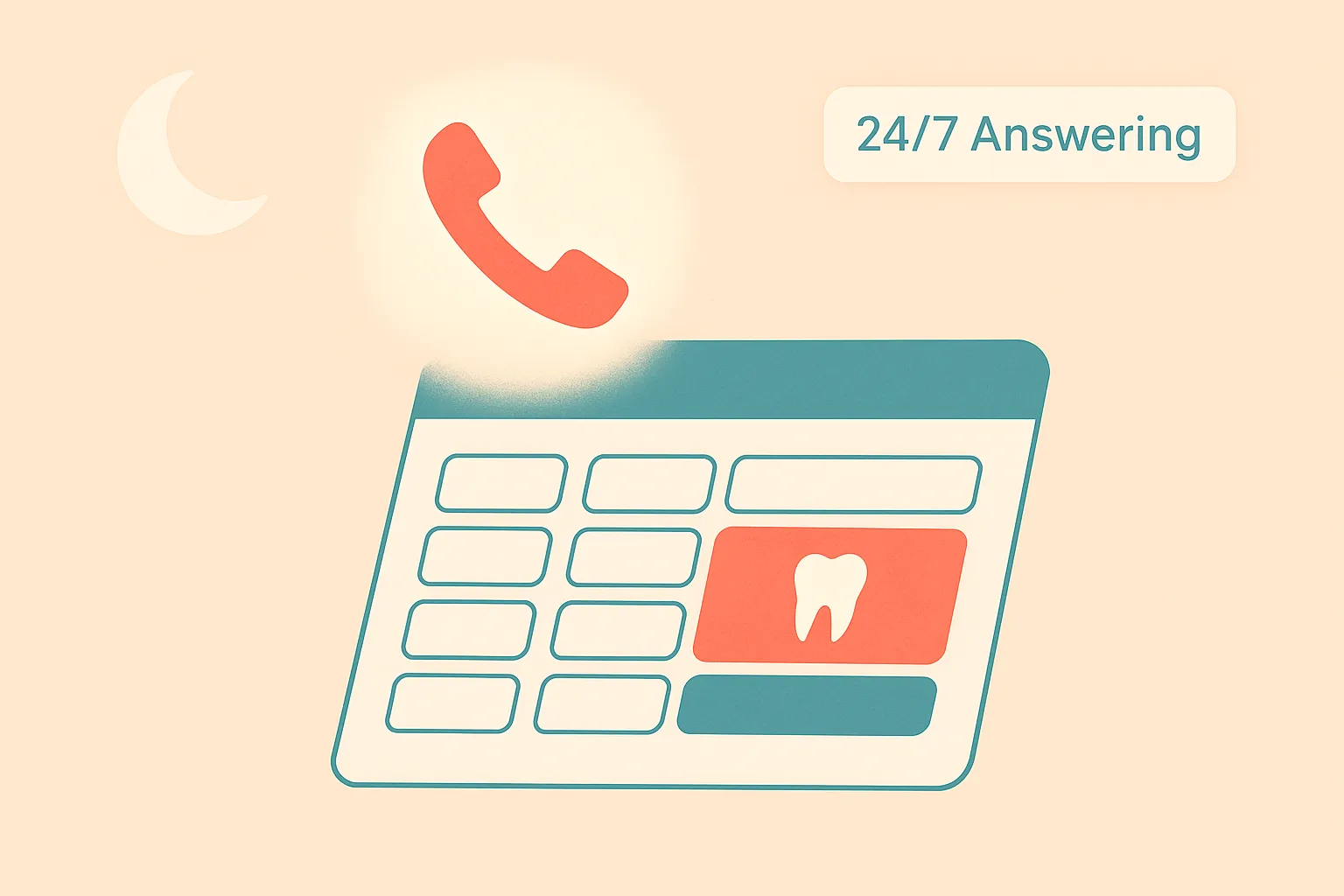
Most dental practices have a revenue leak they can’t see on their P&L. It doesn’t show up as an expense. It shows up as nothing — appointments never booked, new patients who called and hung up, revenue that never materialized.
It’s missed calls. And the cost is almost always larger than practice owners estimate.
The Real Cost of a Missed Call in Dentistry
Let’s start with the numbers most practices don’t track.
The average new dental patient is worth $1,200 in the first year and $400-600 annually in ongoing care, assuming reasonable retention. Over a five-year relationship, a new patient represents $3,000-$4,200 in lifetime value — more for patients who accept restorative or cosmetic treatment.
Industry research shows that 62% of calls to dental offices during peak hours go unanswered. After-hours, that number is effectively 100% for practices without an answering solution. Most patients — over 80% — won’t leave a voicemail. They hang up and call the next practice on their list.
Assume a practice misses 15 new patient call attempts per month. If 30% would have booked (a conservative estimate for a responsive practice), that’s 4-5 patients per month who never became patients. At $1,200 average first-year value, that’s $5,000-$6,000 per month in new patient revenue that never happened.
Annualized: $60,000-$72,000 in lost new patient revenue from missed calls alone.
That’s before accounting for existing patients who couldn’t reach the practice to reschedule, recall appointments that fell through because no one followed up, or high-value cases where the patient called and didn’t connect.
When Calls Get Missed
Understanding when calls get missed helps identify where the problem is largest.
After Hours
The most obvious gap: practices are closed 12-16 hours per day. Patients call when they have time — evenings, early mornings, weekends. A practice closed Tuesday and Thursday gets missed calls those entire days. After-hours calls go to voicemail universally.
Lunch Breaks and Staff Meetings
Front desks aren’t fully staffed at every moment of the business day. Lunch breaks, team huddles, and staff coverage gaps create smaller but consistent windows where calls go unanswered or to a phone tree nobody answers.
Peak Volume
When the phone rings multiple times simultaneously — not uncommon at busy practices — some calls don’t get answered. The front desk is on one call while a second and third ring through.
Patient Situations Requiring Extended Calls
When a front desk team member is deep in a complex insurance call or a patient needs extended help at the front desk, incoming calls get neglected. There’s no solution here except more staff or a system that handles overflow automatically.
Why Voicemail Isn’t a Solution
Most practices respond to the missed call problem by pointing to their voicemail setup. Patients can leave a message; someone will call back.
The data says this doesn’t work.
Over 80% of dental patients who reach voicemail hang up without leaving a message. Of those who do leave messages, many don’t answer when the practice calls back — setting up a game of phone tag that often doesn’t resolve. Of those who eventually connect via callback, some have already booked elsewhere.
Voicemail converts at a fraction of the rate of a live answer. For new patients specifically — who don’t have an established relationship with the practice and are choosing between multiple options — voicemail is often a dead end.
How AI Answering Changes the Math
GetHelpdesk.AI addresses missed calls by answering every call, every time — including after hours, during lunch, and during peak volume periods.
The AI picks up in under one second, has a natural conversation in the patient’s language, and books the appointment directly into your practice management system. Not a message. An actual booking, in your PMS, confirmed during the call.
What That Looks Like in Practice
A patient calls at 9 PM on a Sunday about a cleaning appointment. GetHelpdesk.AI answers immediately, confirms their preference for a specific time range, checks your PMS for availability, books the hygiene appointment with the correct duration and provider assignment, and sends a confirmation. The call takes about two minutes. By Monday morning, the appointment is already in your schedule.
The same patient calling the same practice without AI answering gets voicemail. Most don’t leave a message. If they do, the callback might happen Monday afternoon — 15+ hours later — if the patient answers.
The Volume Impact
Across GetHelpdesk.AI’s 30+ active practices:
- 5,000+ calls answered monthly — the majority of which would otherwise go unanswered or to voicemail
- 400+ appointments booked monthly — directly in PMS, during the call
- $200K+ in patient revenue facilitated monthly — tracked across booking types
One solo practice in Texas reported that after enabling GetHelpdesk.AI, they captured 22 new patient bookings in the first month that arrived after hours or on their closed day. At their new patient value, that single month exceeded the annual subscription cost by 8x.
Closed-Day Coverage: The Underrated Opportunity
Many dental practices are closed one or more days per week — commonly Mondays, Fridays, or one full day mid-week. These are significant missed call windows that practices rarely think about systematically.
A practice closed every Monday receives calls that day from patients who checked the website and still tried. Without AI answering, every Monday call goes to voicemail. With AI answering, Monday becomes a booking day even though no staff is present.
The same logic applies to holidays, staff training days, and any other unscheduled closure. AI answering converts dead days into productive booking periods.
The Staff Efficiency Gain
Beyond the revenue impact, AI answering changes how front desk staff spend their time. The calls that previously went unanswered — or required callbacks, voicemail management, and phone tag — are handled automatically.
Staff arrive Monday morning to a schedule that’s already partially filled by weekend and Sunday-evening AI bookings. They don’t start the week playing catch-up on missed calls from Friday and Saturday.
The result: front desk time redirects toward higher-value in-office interactions — helping patients at the desk, managing complex scheduling situations, handling insurance, building relationships with in-office patients.
Key Takeaways
- The average practice loses $60,000-$72,000 annually in new patient revenue from missed calls — and most don’t track it
- Over 80% of patients who reach voicemail don’t leave a message — voicemail is not a solution for missed calls
- After hours, lunch breaks, peak volume, and closed days create consistent missed call patterns that AI answering addresses completely
- AI answering that books directly into your PMS — not just takes messages — converts calls at dramatically higher rates
- Closed days become productive booking periods when AI answering is active
Frequently Asked Questions
How many calls does a typical dental practice miss per day? It varies significantly by practice size and staffing model. Industry research suggests 30-40% of calls during business hours go unanswered. After hours, the number is effectively 100% without an answering solution. A 50-call-per-day practice missing 35% of calls loses 17-18 call attempts daily.
What if patients don’t want to talk to an AI? The vast majority of patients don’t identify the system as AI during the interaction — they experience a natural, helpful conversation that resolves their need. Patient satisfaction with AI-answered calls is generally high when the AI books their appointment successfully. The friction point is voicemail, not AI.
Does AI answering work for existing patients calling to reschedule? Yes. GetHelpdesk.AI handles reschedule requests from existing patients just as effectively as new patient bookings — it accesses your PMS, finds the existing appointment, cancels it, and books the new time. The patient experience is the same regardless of whether they’re new or established.
How quickly can a practice get AI answering set up? Most GetHelpdesk.AI practices are live within a week of their onboarding call. The configuration process covers your scheduling rules, appointment types, provider preferences, and practice information.
Can the AI handle calls in languages other than English? GetHelpdesk.AI supports 25+ languages automatically. The AI detects the caller’s language from the conversation and responds accordingly — no manual routing or setup required.
Stop calculating missed call losses and start capturing them instead. Book a demo to see GetHelpdesk.AI answer a call for your practice in real time.
Related Posts
10 Signs Your Dental Practice Needs an AI Answering Service
Not sure if AI answering is right for your practice? These 10 signals — from missed calls to Monday morning voicemail backlogs — tell you the answer.
AI 101 for Dentists: A Plain-Language Guide to What It Is and What It Does
Artificial intelligence sounds complicated until you see what it actually does at a dental practice. This guide explains the concepts that matter — and skips the ones that don't.
AI Answering Service for Dental Practices: The Complete Guide
Everything dental practice owners need to know about AI answering services — how they work, what they cost, what to look for, and how they compare to traditional solutions.