
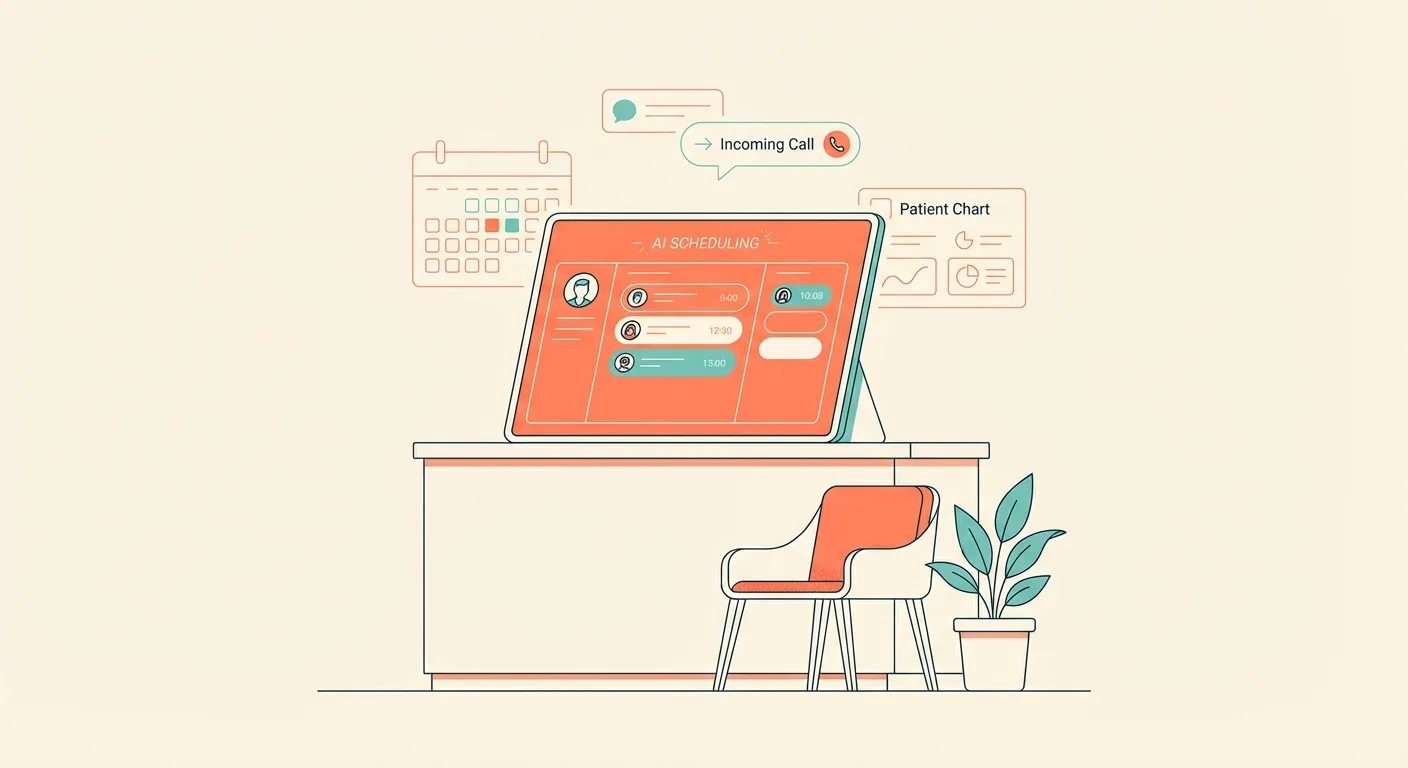
The dental practice that looked efficient five years ago would struggle to compete today. Patient expectations have shifted — they want instant answers, same-day restorations, and the convenience of digital-first communication. Meanwhile, staffing shortages mean lean front desks are being asked to do more with less.
The good news: dental technology in 2025 is purpose-built to close that gap. These five innovations aren’t just novelties — they directly impact patient acquisition, retention, and practice profitability. Here’s what’s transforming dental clinics right now and how each one changes the numbers for your practice.
1. AI-Powered Diagnostic Imaging
Dentistry has always depended on the dentist’s eye. But the human eye — even the most experienced one — misses early-stage pathology at a rate that would surprise most patients. AI diagnostic tools like Overjet and Pearl AI are changing that reality.
These platforms run in the background while a dentist reviews X-rays, flagging potential areas of concern in real time: early interproximal decay, bone loss patterns, calculus buildup, and more. They learn from millions of annotated dental radiographs, which means they’ve “seen” more cases than any single clinician.
What This Means in Practice
The impact isn’t just clinical accuracy — it’s the conversation that follows. When a dentist can show a patient an AI-flagged X-ray with annotations highlighting a problem area, treatment acceptance rates climb. Patients who might have waited on that crown feel more urgency.
Practices using AI diagnostic imaging report 15-20% increases in case acceptance for high-value procedures. At $1,500-$4,000 per crown or $3,000+ for an implant, even a handful of additional accepted cases per month changes a practice’s revenue trajectory meaningfully.
The Cost Reality
These tools range from $300-$700/month for most practice sizes. The break-even point — typically one additional accepted case per month — is achievable for most practices with moderate case volume.
2. In-House 3D Printing for Same-Day Restorations
The traditional dental restoration workflow had a design flaw baked in: send impressions to an outside lab, wait 2-3 weeks, schedule a second appointment, hope for a good fit. Every step was friction — for the patient and the practice.
In-house 3D printing paired with CAD/CAM software has compressed that workflow to a single appointment in many cases. A dentist preps the tooth, takes a digital scan, designs the restoration on-screen, prints or mills it in the operatory, and seats it — all within a few hours.
The Patient Experience Shift
For patients, this is transformative. “Come back in two weeks” becomes “We can do this today.” Same-day crown appointments convert differently from multi-visit treatments — no second appointment to reschedule, no temporary restoration to fail, no waiting period during which patients sometimes change their mind about moving forward.
Practice Economics
The upfront investment is substantial ($30,000-$100,000+ for a complete CAD/CAM and printing setup), but the math works for practices with sufficient restoration volume. Eliminating lab fees ($75-$200 per unit) while charging full retail adds margin. More importantly, capturing same-day restorations that patients might delay or decline entirely changes the revenue mix.
3. Teledentistry and Virtual Consultations
Teledentistry crossed a threshold during the pandemic — it went from experimental to expected. What surprised many practice owners was that patients liked it and kept preferring it even after in-person appointments became universally available again.
Virtual consultations now serve several functions in a modern practice:
- New patient consultations for orthodontic cases, implant discussions, or cosmetic evaluations — patients can “meet” the practice before committing to an in-person appointment
- Post-op check-ins that would otherwise require a chair and staff time
- Emergency triage to determine whether a patient needs to come in urgently or can wait
- Second opinions from specialists without requiring patient travel
Why This Matters Beyond Convenience
Teledentistry is a patient acquisition tool, not just a convenience feature. Practices that offer free 15-minute virtual consultations for cosmetic cases close significantly more elective treatment because they lower the barrier to that first conversation.
A patient curious about Invisalign or veneers may hesitate to schedule an hour-long in-office consultation. A 15-minute Zoom call removes that friction completely. The conversion rate from virtual consultation to scheduled treatment is typically higher than cold leads who schedule in-person consultations directly.
4. Robotic-Assisted Dental Procedures
Robotics in dentistry has moved from academic research to active clinical use faster than most practitioners expected. Systems like Yomi (for implant placement guidance) use real-time haptic feedback to guide a dentist’s drill along a pre-planned path with sub-millimeter accuracy.
This isn’t “a robot doing the surgery.” The dentist remains in complete control. What the robotic guidance system does is act as a precision constraint — physically preventing the drill from deviating from the surgical plan even if there’s hand tremor, unexpected patient movement, or challenging anatomy.
Clinical and Business Implications
For implant-heavy practices, robotic guidance changes the risk calculus. Fewer complications, more predictable healing times, and better outcomes for complex cases translate to better reviews, stronger referrals, and the ability to take on cases that might previously have been referred out.
The business case is strongest for practices doing 15+ implants per month. At that volume, the improved case acceptance (patients prefer “robot-assisted precision” framing), reduced complication rate, and premium pricing potential justify the investment.
5. AI Front Desk Assistants: The Front Office Revolution
Every other innovation on this list touches clinical care. This one touches every call, every booking request, every after-hours inquiry — which is to say, it touches everything else.
The dental front desk is the revenue gateway of a practice. Every missed call is a missed patient. Every patient who goes to voicemail and doesn’t leave a message (62% of them, per industry data) is revenue that walks to a competitor. Every appointment booked incorrectly creates downstream chaos: double-bookings, wrong provider assignments, operatory conflicts.
Traditional solutions — hiring more front desk staff, using a human answering service — are expensive and only partially effective. Human answering services can take messages, but they can’t access your practice management system to book appointments in real time.
What GetHelpdesk.AI Does Differently
GetHelpdesk.AI is an AI receptionist that integrates directly with your practice management system. When a patient calls after hours, on a closed day, or during a busy stretch when your front desk is in-office with a patient — GetHelpdesk.AI picks up, has a natural conversation, and books the appointment directly into your PMS.
Not a message. Not a callback request. An actual booked appointment with the right provider, in the right operatory, at the right time — following your scheduling rules.
For practices on OpenDental, Dentrix, or Eaglesoft, this means 24/7 scheduling intelligence that works the way your best front desk person would — without overtime costs or coverage gaps.
The results across 30+ active practices: 5,000+ calls answered monthly, 400+ appointments booked, and $200K+ in patient revenue facilitated. One practice went from missing 40% of after-hours calls to booking 46 appointments in a single month during closed-day coverage alone.
Key Takeaways
- AI diagnostic imaging increases treatment acceptance by making pathology visible and undeniable — 15-20% case acceptance improvements are common
- In-house 3D printing collapses multi-visit restorations into single appointments, reducing patient dropout and adding margin by eliminating lab fees
- Teledentistry lowers the barrier for cosmetic and elective consultations, converting curious patients into committed ones
- Robotic-assisted procedures reduce implant complication risk and enable premium positioning for complex cases
- AI front desk systems stop the revenue leak from missed calls, after-hours gaps, and scheduling errors — the highest-ROI technology on this list for most practices
Frequently Asked Questions
Which dental technology innovation has the fastest ROI? For most practices, AI front desk and scheduling technology delivers the fastest return — often within the first month. Unlike capital equipment, there’s no large upfront cost, and the revenue impact (captured after-hours appointments, reduced missed calls) shows up immediately.
Do I need to use all five technologies to stay competitive? No. Start with the innovation that addresses your biggest current pain point. If missed calls and after-hours coverage are bleeding revenue, start there. If case acceptance on high-value procedures is your challenge, AI diagnostics or same-day restoration capability may matter more.
Is 3D printing worth the investment for a solo practitioner? It depends on volume. Solo practices doing fewer than 30-40 crown/restoration cases per month may find the ROI timeline too long. Practices with higher restorative volume — particularly those already sending significant lab fees — typically break even within 18-24 months.
How do AI front desk systems handle complex patient questions? Modern AI receptionists like GetHelpdesk.AI are trained on practice-specific information — your hours, insurance policies, provider specialties, appointment types. They handle routine questions with high accuracy and route genuinely complex clinical questions to voicemail or a staff callback, depending on your configured preferences.
What’s the biggest mistake practices make when adopting dental technology? Adopting technology without a plan for patient communication. The practice that gets the most from same-day crowns is the one that trains front desk to explain the benefit during scheduling calls. The practice that gets the most from AI diagnostics is the one that integrates the AI findings into a consistent case presentation script. Technology amplifies the practices that surround it.
Ready to stop losing patients to missed calls? Book a 9-minute demo to see how GetHelpdesk.AI books appointments directly into your schedule — 24/7.
Related Posts

10 Signs Your Dental Practice Needs an AI Answering Service
Not sure if AI answering is right for your practice? These 10 signals — from missed calls to Monday morning voicemail backlogs — tell you the answer.
AI 101 for Dentists: A Plain-Language Guide to What It Is and What It Does
Artificial intelligence sounds complicated until you see what it actually does at a dental practice. This guide explains the concepts that matter — and skips the ones that don't.
AI Answering Service for Dental Practices: The Complete Guide
Everything dental practice owners need to know about AI answering services — how they work, what they cost, what to look for, and how they compare to traditional solutions.