
Most dental practice owners don’t need a technical education in artificial intelligence. They need to understand what it does for their practice, whether it works, and whether the investment makes sense.
This guide covers exactly that. No jargon. No hype. Just a clear explanation of what AI is, how it applies to dental practices, and what the realistic outcomes look like when it’s deployed well.
What AI Actually Is (In Plain Language)
Artificial intelligence is software that processes information and makes decisions in ways that used to require human intelligence.
The key word is “decisions.” A spreadsheet processes data but doesn’t decide anything. AI software processes data and determines what to do with it — what a caller probably wants, which appointment slot fits best, whether a situation is an emergency or routine.
For dental practices, three types of AI are most relevant:
Natural Language Processing (NLP)
This is the technology that allows AI to understand human speech and text. When a patient calls and says “I’d like to come in for a cleaning sometime next week,” NLP processes the sentence and extracts the meaning: appointment type (cleaning), timeframe (next week), action needed (booking).
Without NLP, a phone system can only respond to exact commands. With it, it can have a real conversation. NLP is what powers AI dental assistants that handle calls the way a trained receptionist would.
Machine Learning
Machine learning is how AI systems improve over time. Rather than being programmed with fixed rules, ML systems learn patterns from data.
For dental AI, this means the system gets better at understanding your specific patient population’s language patterns, the appointment types most frequently requested, and the questions most commonly asked. Over time, the AI becomes more accurate for your practice specifically.
Intelligent Scheduling
This combines rule-following with real-time data. The AI knows your scheduling rules — which providers do which procedures, how long each appointment type takes, which rooms are appropriate for which treatments — and applies them to real-time availability data from your practice management system.
The result: booked appointments that actually work for your operations, not just any open slot.
How AI Is Currently Used in Dental Practices
AI in dentistry isn’t a future concept — it’s in active use across thousands of practices right now. The applications fall into two broad categories: clinical and administrative.
Clinical AI Applications
Diagnostic imaging assistance: AI tools like Overjet and Pearl analyze dental X-rays and flag potential pathology — early decay, bone loss, calculus — in real time alongside the dentist’s review. These systems have been trained on millions of annotated radiographs.
Treatment planning support: AI systems can analyze patient history, imaging, and clinical notes to surface relevant treatment considerations, helping ensure nothing is overlooked in complex cases.
Outcome prediction: Some systems use patient data to model predicted treatment outcomes, helping with case presentations and patient conversations.
Administrative AI Applications
Phone answering and scheduling: AI answers patient calls, has natural conversations, and books appointments directly into the practice management system — 24/7, in multiple languages.
Appointment reminders and recall: Automated systems send personalized reminders, confirm appointments, and manage the recall process for overdue patients.
Insurance verification: Some AI systems automate the routine process of checking insurance eligibility before appointments.
Review monitoring and response: AI can monitor new online reviews and draft responses for practice managers to approve.
For most general dental practices evaluating AI for the first time, phone answering and scheduling delivers the fastest, most measurable return — because it directly affects the revenue from every call.
The Specific Problem AI Answering Solves
Dental practices lose revenue every day to a simple, fixable problem: the phone goes unanswered.
Practices are closed 12-16 hours per day. During business hours, front desks are often occupied with in-office patients when the phone rings. Lunch breaks, peak morning call volume, and staff coverage gaps create additional windows where calls go to voicemail.
Over 80% of patients who reach voicemail don’t leave a message. They call another practice.
The cost of missed calls adds up to tens of thousands of dollars per year in lost new patient revenue for most practices — revenue that’s invisible on the P&L because it never materialized.
AI answering addresses this by picking up every call, immediately, at any hour. The AI has a natural conversation and books the appointment before the call ends. No message. No callback. No phone tag.
What AI Is Not
Understanding AI also means knowing what it isn’t — because vendor overpromising is common.
AI is not infallible. Well-configured systems make very few errors. Poorly configured ones make many. The quality of setup matters enormously.
AI does not replace clinical judgment. In diagnostic imaging applications, AI flags areas of concern — the dentist diagnoses and treats. AI is a tool, not a clinician.
AI does not replace your front desk team. AI handles the volume and repetitive elements — answering phones, booking routine appointments, providing standard information. Human staff handle relationship-building, complex situations, and the in-person experience that patients actually remember.
AI is not the same as automation. Simple automation follows fixed rules: “if X happens, do Y.” AI adapts. It handles variations, unexpected inputs, and novel situations in ways that simple automation cannot.
What Makes AI Succeed or Fail in a Dental Practice
AI deployments that work well share common characteristics. Those that disappoint share others.
What Makes AI Work
Proper configuration. The AI must be configured with your specific practice information — scheduling rules, providers, appointment types, insurance accepted, hours. Generic AI fails because it doesn’t know your practice. Configured AI works because it does.
Clear scope. AI excels at well-defined tasks: answer calls, book appointments, answer common questions, triage emergencies. When the scope is clear, performance is high.
Integration depth. AI that integrates directly with your PMS — reading and writing appointments in real time — delivers different outcomes than AI that collects messages for human follow-up.
Realistic expectations. AI handles defined categories of calls extremely well and complex edge cases less well. Knowing the difference allows you to configure escalation paths appropriately.
What Makes AI Fail
Deploying the wrong tool. A website chatbot is not a phone answering system. Expecting either to do what the other does leads to disappointment.
Poor configuration. AI trained on generic dental content but not your practice’s specific information gives wrong answers — wrong hours, wrong insurance info, wrong procedures.
No human backup. AI handles most calls well. Some calls need humans. Without clear escalation paths, edge cases fall through the cracks.
Getting Started: What to Evaluate First
For dental practices new to AI, the evaluation process should start with the problem to solve, not the technology.
Most common starting point: Phone coverage gaps — missed calls, after-hours voicemail, closed-day blackouts.
Evaluation questions:
- How many calls does your practice miss per week?
- How many after-hours calls come in?
- How much does your Monday morning voicemail backlog cost in callback time?
- What’s your current new patient booking rate from inbound calls?
These numbers establish a baseline. After deploying AI answering, the same metrics show the impact: fewer missed calls, more after-hours bookings, smaller Monday backlog, higher conversion rate.
GetHelpdesk.AI integrates with OpenDental, Dentrix, Eaglesoft, and iDentalSoft. Most practices are live within a week of the onboarding call.
Key Takeaways
- AI is software that processes information and makes decisions — for dental practices, the most relevant applications are phone answering, diagnostic imaging, and scheduling
- NLP (natural language processing) is what allows AI to understand natural patient conversations, not just exact commands
- AI answering solves the missed call problem: over 80% of patients who reach voicemail don’t call back
- Configuration quality determines outcomes — AI trained on your specific practice information outperforms generic systems dramatically
- AI doesn’t replace front desk teams — it handles volume and repetition so humans can focus on relationship and complexity
- Start with your biggest problem (usually phone coverage) before expanding to other AI applications
Frequently Asked Questions
Do I need technical expertise to use AI tools in my practice? No. The configuration is handled by the vendor during onboarding. Your team uses the outcomes — a booked schedule, call transcripts, analytics — without managing any technical infrastructure.
How is AI different from the automated phone systems my practice already uses? Traditional phone trees are rule-based: press 1 for appointments, press 2 for billing. AI is conversational: it understands what you say and responds accordingly. The patient experience is completely different.
What if AI makes a booking error? Well-configured systems make very few booking errors because they apply your scheduling rules consistently. When errors occur, they show up in call transcripts and appointment records for correction. Systematic errors (if any) are addressed through configuration updates.
Is AI answering HIPAA compliant? GetHelpdesk.AI is fully HIPAA compliant — encrypted data, secure storage, BAA available. Any AI system handling patient information in a dental context should meet the same standard.
What’s the best first AI application for a small or solo practice? Phone answering and after-hours coverage. The economics work clearly: even a small practice missing 10 calls per week, with a 30% booking rate, is losing 3 appointments per week. At $200 average appointment value, that’s $600/week or $30,000/year in lost revenue — more than the annual cost of AI answering.
Understanding the basics is step one. Book a 9-minute demo to see what AI answering looks like at a practice like yours.
Related Posts
10 Signs Your Dental Practice Needs an AI Answering Service
Not sure if AI answering is right for your practice? These 10 signals — from missed calls to Monday morning voicemail backlogs — tell you the answer.
AI Answering Service for Dental Practices: The Complete Guide
Everything dental practice owners need to know about AI answering services — how they work, what they cost, what to look for, and how they compare to traditional solutions.
Seamless Integration of AI Answering Service with Your Dental Software
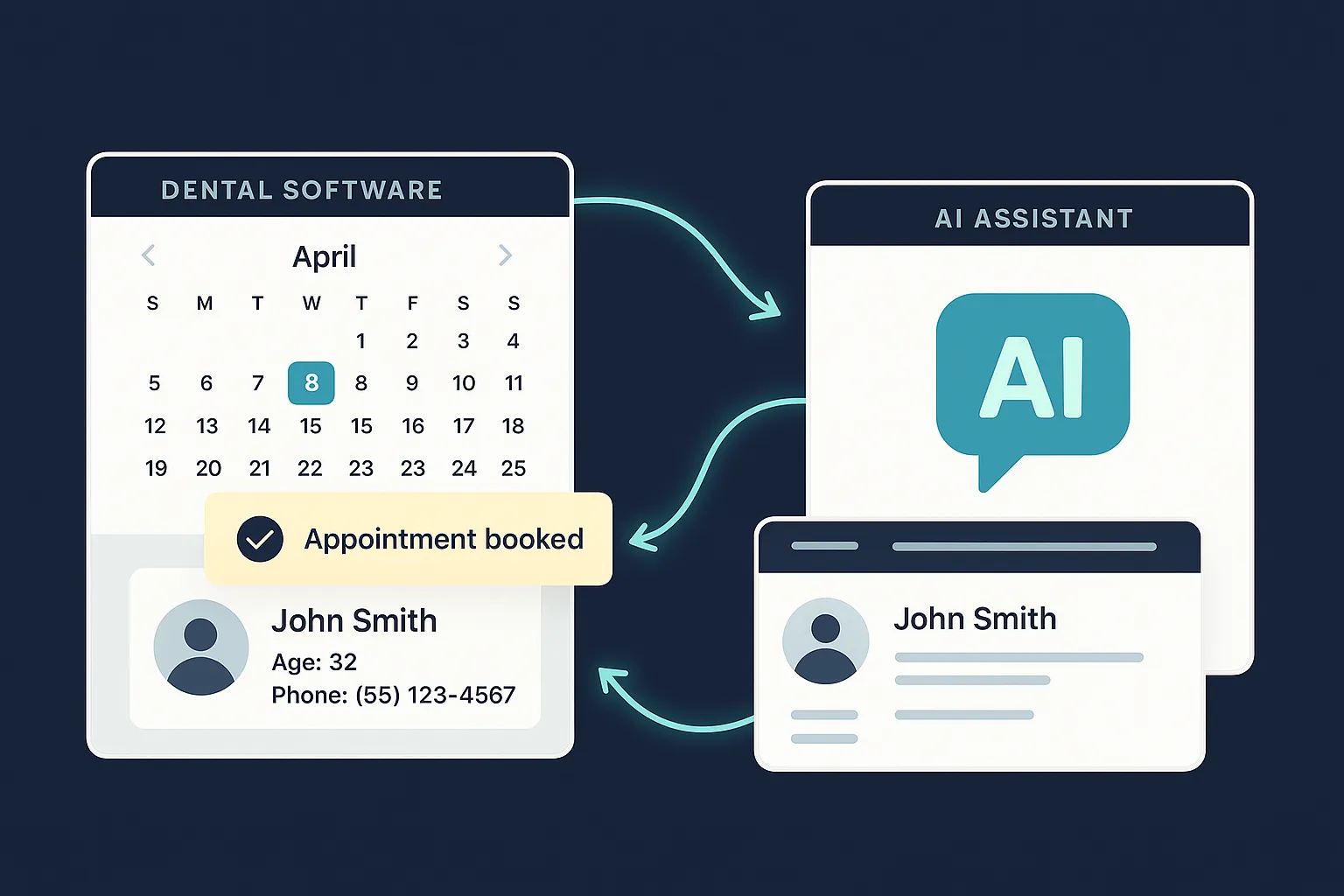
Learn how GetHelpdesk.AI integrates effortlessly with popular dental practice management software, syncing appointments, patient data, and streamlining your workflow.