If you’ve looked into AI answering services for your dental practice, you’ve probably encountered the term NLP — natural language processing. Vendor websites mention it prominently. It sounds sophisticated. But what does it actually mean for your practice, and why should you care?
This article explains NLP in the context of dental AI without the technical jargon — what it does, why it matters for patient conversations, and what separates good NLP from basic keyword matching.
What NLP Actually Is
Natural language processing is the branch of artificial intelligence focused on understanding human language. Not just individual words — but meaning, context, and intent.
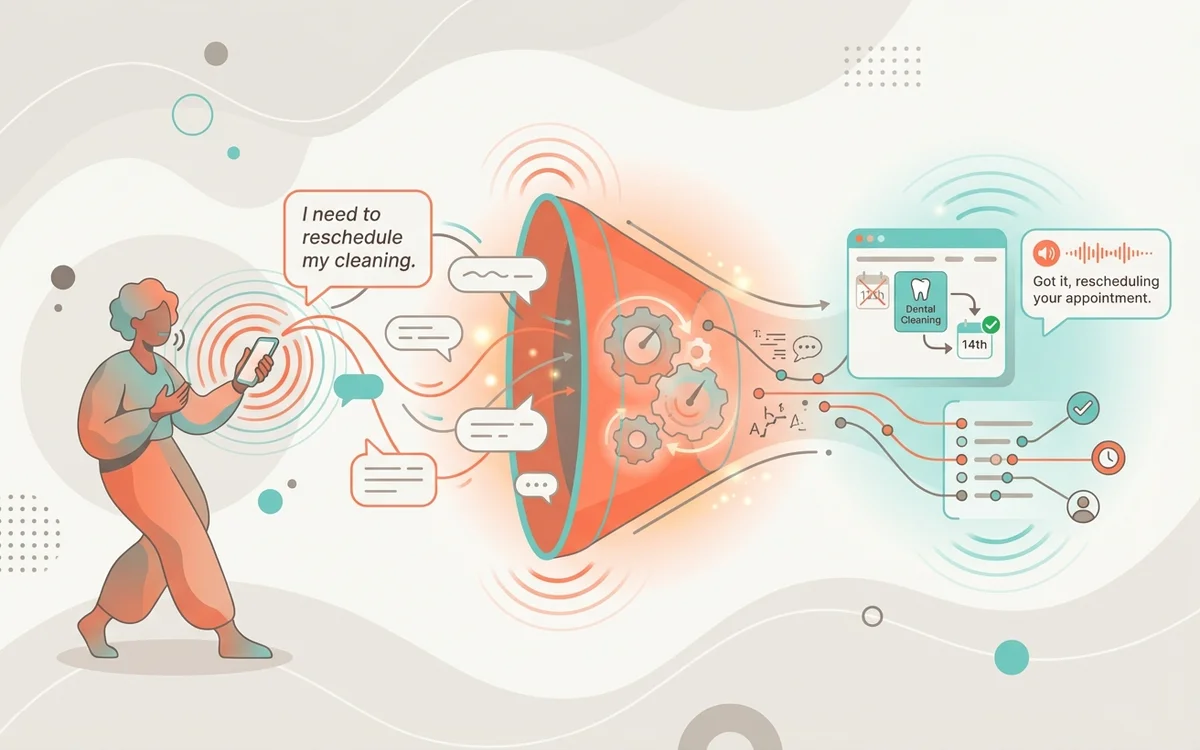
Without NLP, a computer system treats language as data. “I need a cleaning” and “I’d like to schedule a dental hygiene appointment” look completely different to a basic system — different words, different sentence structure, different length. A keyword-matching system might catch “cleaning” but miss “dental hygiene appointment” entirely.
With NLP, both sentences are understood to mean the same thing: the caller wants to book a hygiene appointment. The system extracts the intent, not just the keywords.
This is the foundational capability that allows AI dental assistants to have actual conversations rather than navigating callers through rigid menu trees.
Why NLP Matters for Dental Practice Phone Calls
Dental patient phone calls are remarkably diverse in how patients express the same needs. Consider the different ways patients ask for essentially the same thing:
Booking a new patient appointment:
- “I’d like to become a new patient”
- “I need a dentist — do you accept new patients?”
- “My friend recommended you. Can I come in for a checkup?”
- “I haven’t been to a dentist in a few years and I need to start somewhere”
Asking about insurance:
- “Do you take Delta Dental?”
- “I have BlueCross — does that work?”
- “What insurance do you accept?”
- “Am I covered at your office?”
Scheduling an emergency:
- “I broke my tooth”
- “I’m in a lot of pain”
- “Something happened to my crown and it’s really bothering me”
- “I need to come in today — it’s urgent”
A rigid system without NLP might handle the first phrasing of each category but fail on the variations. NLP-powered systems understand all of them because they process meaning, not just keywords.
How NLP Works in a Dental AI Call
When a patient calls a practice using an NLP-powered AI assistant, the system processes the conversation through several layers simultaneously.
Intent Recognition
The first task: what does the caller want? Intent recognition classifies the caller’s request into categories: booking an appointment, asking a question, reporting an emergency, requesting insurance information, etc.
Good NLP systems recognize intent even when it’s expressed indirectly. “I was wondering if maybe I could come in sometime next week?” is a booking request, even though it doesn’t contain the word “appointment.”
Entity Extraction
Once intent is identified, the system extracts specific details: appointment type, preferred date/time, provider name, insurance carrier, etc. These are the “entities” — the concrete pieces of information needed to take action.
“I need a cleaning next Tuesday with Dr. Smith” contains three entities: appointment type (cleaning), date (next Tuesday), and provider (Dr. Smith).
Context Management
Conversations aren’t single-turn exchanges. Patients change topics, ask follow-up questions, and circle back to earlier points. Context management tracks the state of the conversation across multiple turns.
Patient: “Can I book a cleaning?” AI: “I’d be happy to help. We have openings Thursday at 2 PM and Friday at 10 AM.” Patient: “Wait — do you accept Cigna?” AI: “Yes, we accept Cigna dental plans. Would you like Thursday at 2 or Friday at 10?”
The context manager tracks that the insurance question is a sidebar — the booking conversation isn’t over. After answering, it returns to the original thread.
Sentiment Detection
NLP can detect emotional signals in language. A patient expressing urgency (“I’m in a lot of pain, I really need to be seen today”) gets different handling than a patient making a routine request. This allows the AI to adjust tone and prioritize emergency routing appropriately.
What Separates Good NLP from Basic Systems
Not all AI dental assistants use the same quality of NLP. The differences are substantial and directly affect patient experience.
Keyword Matching vs. True Understanding
Basic systems match keywords to responses: “cleaning” triggers the cleaning booking flow, “insurance” triggers the insurance answer. If the patient phrases their request differently, the system fails or asks them to repeat themselves.
Advanced NLP understands paraphrases, indirect requests, and complex sentence structures. It handles the full diversity of human communication, not just the expected phrasings.
Rigid Scripts vs. Dynamic Conversations
Some AI systems follow scripted conversation trees — they ask Question 1, then Question 2, then Question 3, regardless of what the patient says. If the patient provides information out of order or volunteers details the script hasn’t asked for yet, the system ignores them.
NLP-driven systems adapt to the patient’s communication style. If a patient front-loads all the information (“I need a cleaning next Tuesday morning, I have Delta Dental, and I’m a new patient”), the system captures everything and skips redundant questions.
Single-Language vs. Multi-Language
NLP quality varies significantly across languages. A system that handles English well but struggles with Spanish, Vietnamese, or Mandarin isn’t truly multi-language — it’s English-only with poor translation bolted on.
GetHelpdesk.AI supports 25+ languages with NLP quality that’s consistent across all of them. The system detects the caller’s language automatically and responds fluently, not through translation but through native language processing.
Real-World Impact on Dental Practice Operations
The quality of NLP in a dental AI system translates directly into practical outcomes.
Higher booking completion rates. Better NLP means fewer failed conversations where the patient hangs up frustrated because the system couldn’t understand them.
Fewer unnecessary transfers to staff. When the AI understands the patient’s request, it resolves it. When it doesn’t, it transfers to a human. Better NLP = fewer transfers = less staff interruption.
Better patient satisfaction. Patients don’t know or care about NLP as a technology. They know whether the system understood them, answered their question, and booked their appointment without friction.
More accurate data. Entity extraction quality affects booking accuracy. Good NLP books the right appointment type with the right provider. Poor NLP books the wrong type or misses critical details.
Key Takeaways
- NLP is the technology that allows AI dental assistants to understand what patients mean, not just what words they say
- Patient phone calls express the same needs in dozens of different ways — NLP handles that diversity
- Intent recognition, entity extraction, context management, and sentiment detection work together in every call
- The quality difference between basic keyword matching and advanced NLP directly affects booking rates, transfer rates, and patient satisfaction
- Multi-language NLP quality matters in diverse markets — look for systems with consistent quality across all supported languages
Frequently Asked Questions
Does my staff need to understand NLP to use an AI answering service? No. NLP works entirely behind the scenes. Your team interacts with the results — booked appointments, call transcripts, and flagged items — without needing to understand or manage the underlying technology.
How do I evaluate whether an AI vendor has good NLP? Ask for a demo call where you try multiple phrasings of the same request. Try indirect language, mid-conversation topic changes, and interruptions. Good NLP handles all of these smoothly. Poor NLP breaks on anything unexpected.
Can NLP handle dental-specific terminology? AI systems trained on dental conversations recognize clinical terms, procedure names, and dental-specific phrasing. However, the best systems are also configured with your practice-specific information — your providers, your services, your terminology.
Is NLP the same as ChatGPT? ChatGPT uses NLP (among other technologies), but dental AI answering systems are purpose-built for structured phone conversations — booking appointments, answering specific questions, following practice protocols. The NLP foundation is similar; the application and tuning are very different.
Does NLP quality improve over time? Yes. Both the underlying models and the practice-specific configuration improve as more conversations provide data on how your patients communicate. GetHelpdesk.AI’s system is continuously refined based on real dental practice call patterns.
Ready to hear the difference between basic call handling and NLP-powered conversation? Book a demo and test it with your own questions.
Related Posts
10 Signs Your Dental Practice Needs an AI Answering Service
Not sure if AI answering is right for your practice? These 10 signals — from missed calls to Monday morning voicemail backlogs — tell you the answer.
AI 101 for Dentists: A Plain-Language Guide to What It Is and What It Does
Artificial intelligence sounds complicated until you see what it actually does at a dental practice. This guide explains the concepts that matter — and skips the ones that don't.
AI Answering Service for Dental Practices: The Complete Guide
Everything dental practice owners need to know about AI answering services — how they work, what they cost, what to look for, and how they compare to traditional solutions.