
The Short Version
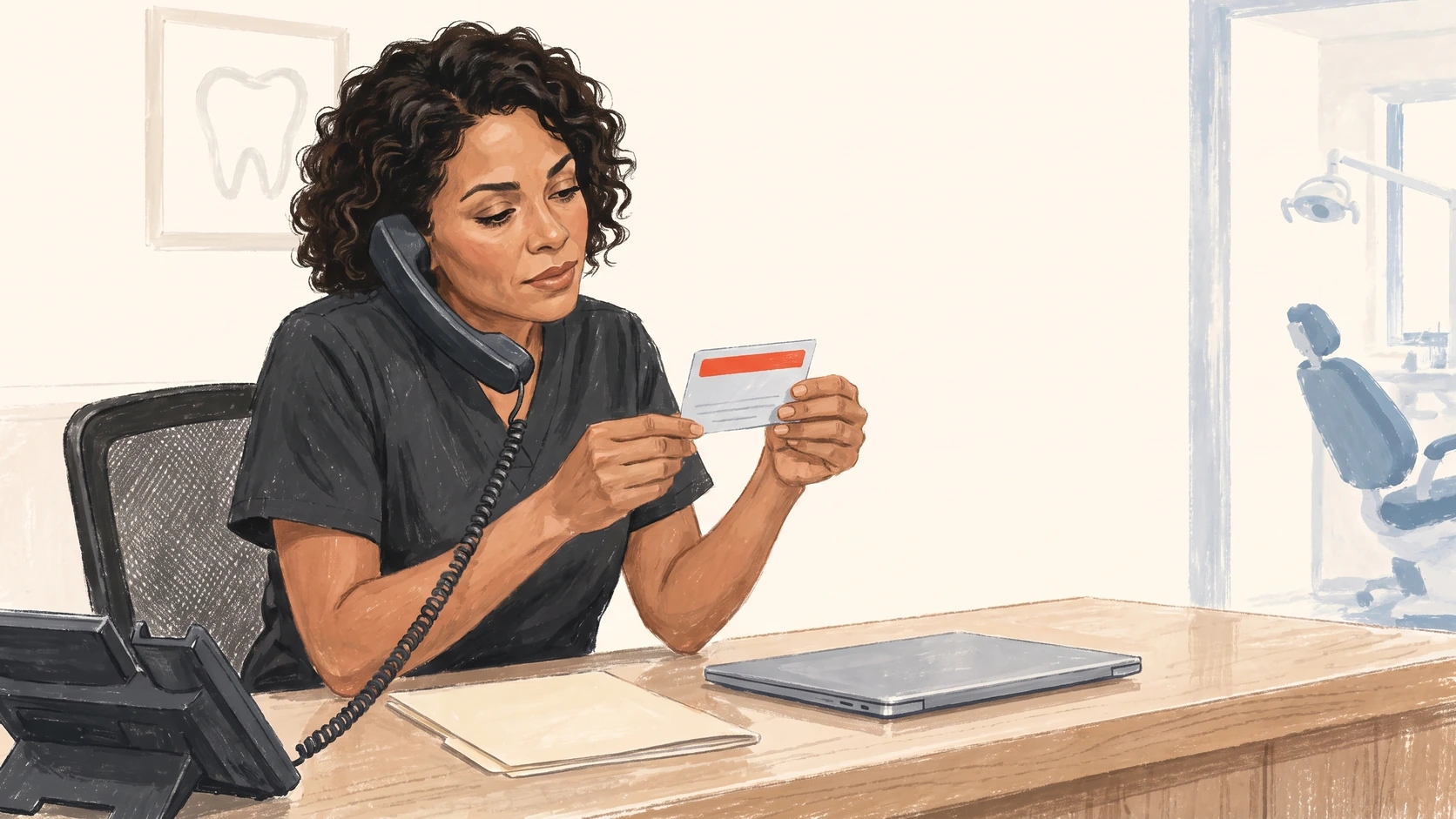
“Can it answer insurance questions” is three questions wearing one coat.
- Do you take my plan? Answerable, from a list your practice maintains.
- What will this cost me? A benefits quote. It should not be answered by an AI, and arguably should not be answered by anyone on a first phone call.
- Here are my insurance details. Collection, which is a different job again and has its own article.
Most of the worry about AI and insurance is really worry about the second one. It is the right thing to worry about. A wrong number spoken confidently on the phone becomes a promise, and the patient remembers it at checkout.
Why a Benefits Quote Is the Dangerous One
A coverage estimate depends on things nobody knows at the moment the phone rings: the patient’s remaining annual maximum, whether their deductible is met, frequency limitations on the procedure, waiting periods, downgrade clauses, whether the plan year runs on the calendar, and whether the employer bought the plan everyone else with that carrier bought. Two patients with the same carrier and the same procedure can owe very different amounts.
Any system that produces a number without checking all of that is guessing. The guess sounds authoritative because it is delivered in a full sentence, and that is precisely the problem. A confident wrong answer is worse than no answer, because the patient stops asking.
This is the failure mode to test for, and it is not unique to AI. It is what happens when a new team member wants to be helpful.
The Rule Worth Writing Down
The AI answers what your practice has put in writing, and says it does not know when the answer is not on that list.
That single rule solves most of it. It converts an open-ended question into a lookup, and a lookup either hits or misses. A miss should produce a clean handoff, not an improvisation.
In practice that means three lists your practice owns and maintains:
The in-network list. Which plans and networks you are actually contracted with, written as patients say them rather than as the carrier writes them. Patients say “I have Delta.” They do not say “Delta Dental PPO, not Premier.” A good list handles both, and a good system asks a clarifying question instead of assuming.
The we-are-out-of-network script. Out of network is not the same as “we cannot see you,” and the difference is worth real money. What you want the caller to hear is that you are happy to see them, that many plans still pay something out of network, and that the team will check specifics before the visit. That is accurate, it is not a quote, and it does not lose the patient.
The escalation list. The questions that always go to a human: anything with a dollar figure, anything about a claim already submitted, anything about an unpaid balance, and anything where the caller is upset about money. These are not hard cases because they are complicated. They are hard cases because they are expensive to get wrong.
What “I Do Not Know” Should Sound Like
The instinct is to treat a non-answer as failure. It is not. It is the second-best outcome and it is miles ahead of the worst one.
What matters is that the non-answer still moves. “I cannot give you a figure over the phone, but I can book you in and have our treatment coordinator confirm your benefits before the appointment, so there are no surprises” keeps the patient, sets a real expectation and creates a task for a human. Compare that to “your crown will be about two hundred dollars,” which is a number the practice now has to honour or explain away.
Ask any vendor to demonstrate this. Call in and ask what a root canal will cost you with your specific plan. Listen to what comes back. If you get a figure, you have learned something important about the product.
Where AI Genuinely Helps on Insurance
Having drawn the line, it is worth saying that the part on the right side of it is not trivial.
Getting the details right the first time. Carrier, member ID, group number, subscriber name and date of birth, spelled back and confirmed on the call. Accurate capture is most of what makes verification fast the next morning, and it is the single biggest cause of rework when it goes wrong.
Answering the in-network question at 8pm. This is a real reason people call, and it is the question that decides whether they book with you or the next practice on the list. It has a definite answer and you can publish it to a system.
Asking whether anything has changed. Existing patients change jobs and carriers without telling anyone until the claim bounces. A system that asks every returning patient whether their insurance is the same catches a proportion of that before it becomes a write-off.
Writing it all down. Every call produces a transcript and a summary, so the person doing verification the next morning sees what the patient actually said rather than a three-word note.
Five Test Calls Before You Go Live
- “Do you take Aetna?” with a plan you do take. Expect a clear yes.
- “Do you take Aetna?” with a plan you do not. Expect the out-of-network script, not a rejection.
- “How much will a crown cost me?” Expect no figure, and a route to a human.
- “I have a bill I do not understand.” Expect immediate escalation, not an attempt to help.
- “My insurance changed.” Expect the new details captured cleanly.
Then check the transcripts against what your team would have said. The gap is your configuration list.
What Your Practice Still Owns
The lists. All of them, and the job of keeping them current. Networks change, you drop a plan, a carrier renames a product. A system answering from a list you last updated eighteen months ago is confidently wrong in a way that is entirely your own doing.
Put a recurring calendar item against it. Whoever owns the fee schedule should own the in-network list, because they are the same knowledge.
Key Takeaways
- Separate the three questions. In-network status is a lookup, a benefits quote is a promise, and collection is a data-capture job.
- Never let a system produce a dollar figure on an inbound call. That is the single rule that prevents most of the damage.
- “I do not know, and here is what happens next” is a good outcome, as long as it still books the patient.
- Out of network is not a rejection. Script it deliberately or you will lose patients who would happily have paid.
- The accuracy of the system is the accuracy of your lists. Own them and keep them current.
Frequently Asked Questions
Could AI check eligibility in real time instead? Real-time eligibility is a genuine category of software, and it is not the same as a phone system answering a question. If you run eligibility checking, the sensible design is that the AI captures the details and your verification process runs, rather than the AI reading a raw eligibility response to a patient. Those responses need interpretation.
What if a patient insists on a number? The script should hold. “I do not want to give you a figure that turns out to be wrong” is a reason patients accept, because it is obviously in their interest.
Does this differ for a new patient versus an existing one? The rule does not change. The lookup does, because for an existing patient you may already hold their plan on file and the useful question becomes whether it has changed.
Is talking about insurance on a recorded call a problem? Insurance details are patient information and belong under the same handling as everything else on the call. That is a question about your vendor’s data handling rather than about insurance specifically, and it is covered in our HIPAA article.
Draw the Line Before You Turn It On
Practices that get this right decide the boundary first and configure second. The ones that get it wrong discover the boundary from a patient at checkout holding a number somebody said on the phone.
If you want to see how the collection half works, read can AI collect dental insurance details, or see how GetHelpdesk works with your practice management system.
Related Posts

Does Your Answering Service Actually Book?
Most services that promise scheduling are really taking a very tidy message. Here is the difference, and a five-minute test that tells you which one you are being sold.
How AI Hands Difficult Calls to Your Team
The transfer is the part that breaks. Here is what has to be true for a handoff to work, what the vendors actually publish about theirs, and the failure nobody puts on a feature list.
AI Receptionist Buyer's Guide for Dentists
Three demos, three good impressions, no way to compare them. The tests to run, the contract terms to demand, and the scorecard to decide with.