
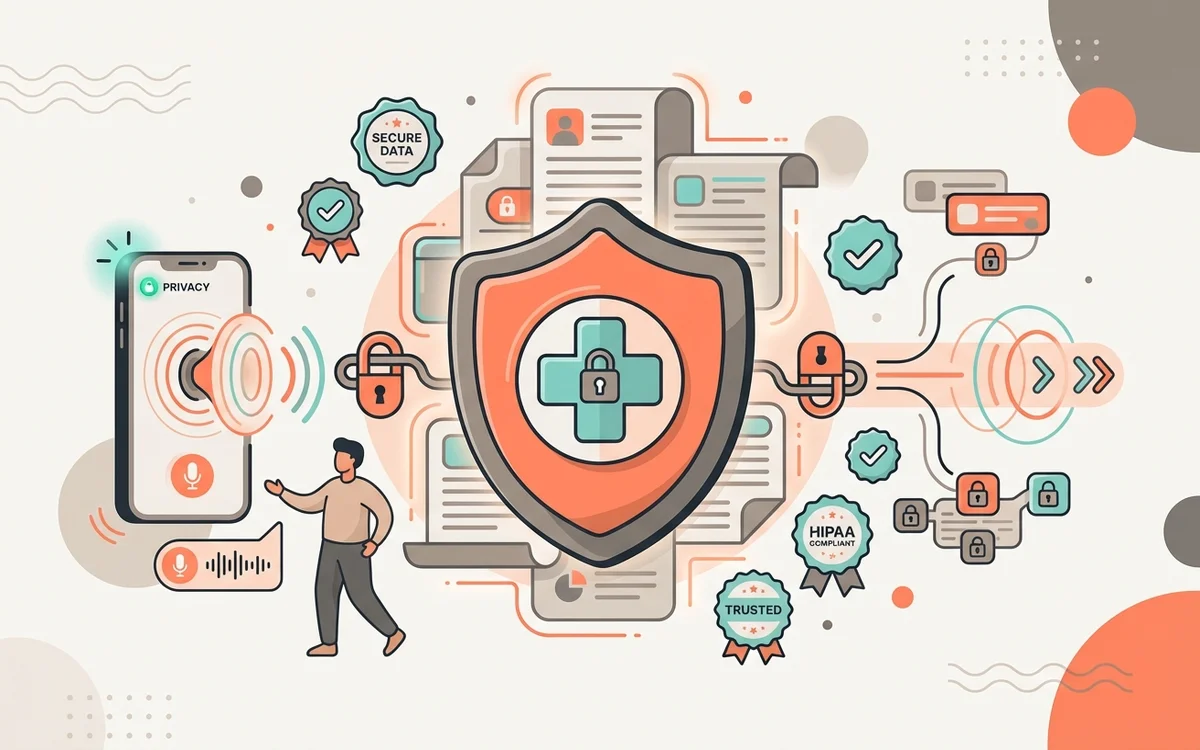
HIPAA Compliance: The Foundation of Trust in Dental AI
For any healthcare practice, especially dental offices, HIPAA compliance is not just a guideline—it’s a legal and ethical imperative. The protection of Protected Health Information (PHI) is paramount. As dental practices increasingly adopt AI-powered solutions, a critical question arises: How do AI Receptionists ensure the confidentiality and security of patient data while remaining fully compliant with HIPAA regulations?
At GetHelpdesk.ai, we understand that trust is built on security. We prioritize HIPAA compliance in every aspect of our AI Answering Assistant, providing dental practices with a powerful tool that doesn’t compromise patient privacy.
Understanding HIPAA and PHI
The Health Insurance Portability and Accountability Act (HIPAA), administered by the U.S. Department of Health and Human Services, sets national standards to protect sensitive patient health information from being disclosed without the patient’s consent or knowledge.
PHI includes any information related to a patient’s physical or mental health, healthcare provision, or payment for healthcare that can be used to identify them. This encompasses:
- Patient names and contact information
- Appointment dates and times
- Treatment plans and clinical notes
- Insurance information and billing records
- Any health-related communications
The Three HIPAA Safeguard Categories
HIPAA compliance for AI solutions requires adherence to three categories of safeguards:
Technical Safeguards: Protecting electronic PHI (ePHI) through access controls, encryption, audit controls, and integrity controls.
Administrative Safeguards: Policies and procedures to manage administrative, technical, and physical safeguards. This includes security management processes, workforce training, and ongoing evaluation.
Physical Safeguards: Protecting physical access to electronic information systems and the facilities where they are housed.
Additionally, any third-party service provider that handles PHI on behalf of a covered entity (like a dental practice) must sign a Business Associate Agreement (BAA), obligating them to comply with HIPAA.
How GetHelpdesk.ai Ensures HIPAA Compliance
Our AI Answering Assistant is built from the ground up with HIPAA compliance as a core design principle. Here’s how we ensure the utmost security and privacy for your patient data:
Robust Data Encryption
All patient data transmitted to and from our AI system is encrypted both in transit (using TLS 1.3) and at rest (using AES-256 encryption). This ensures that even if data were intercepted, it would be completely unreadable without the encryption keys.
We use the same encryption standards trusted by major financial institutions and government agencies.
Secure Hosting Environment
We utilize secure, SOC 2 Type II compliant data centers that adhere to stringent industry standards for physical and environmental security. Key features include:
- 24/7 physical security and surveillance
- Biometric access controls
- Redundant power and cooling systems
- Geographic data redundancy for disaster recovery
Access to these facilities is tightly controlled and continuously monitored.
Strict Access Controls
Access to PHI within our systems is strictly limited to authorized personnel on a need-to-know basis. Our access control framework includes:
- Multi-factor authentication for all system access
- Role-based access with least-privilege principles
- Strong password policies and regular rotation requirements
- Regular access reviews and immediate revocation for departing employees
- Detailed logging of all PHI access
Regular Security Audits and Vulnerability Assessments
We conduct frequent security audits, penetration testing, and vulnerability assessments to identify and address any potential weaknesses in our systems proactively. This includes:
- Annual third-party security audits
- Quarterly penetration testing
- Continuous automated vulnerability scanning
- Bug bounty program for responsible disclosure
Comprehensive Audit Trails
Our systems maintain detailed audit logs of all access and activity related to PHI, allowing for accountability and forensic analysis in case of a security incident. These logs include:
- Timestamp of every access
- User identification
- Type of action performed
- Data elements accessed
- IP address and device information
Audit logs are retained for the required minimum of six years and are tamper-proof.
Business Associate Agreements (BAAs)
GetHelpdesk.ai enters into legally binding Business Associate Agreements (BAAs) with all our dental practice clients. This BAA explicitly outlines:
- Our responsibilities for PHI protection
- Permitted uses and disclosures of PHI
- Breach notification procedures
- Our commitment to upholding HIPAA standards
We also maintain BAAs with our own subcontractors who may have access to PHI.
Staff Training and Awareness
Our team undergoes regular, mandatory HIPAA training to ensure they are fully aware of their responsibilities regarding patient data privacy and security best practices. This includes:
- Initial HIPAA training for all new employees
- Annual refresher training
- Role-specific security training
- Phishing awareness and social engineering prevention
Data Minimization
Our AI is designed to collect and store only the necessary PHI required for its functions, adhering to the principle of data minimization to reduce exposure. We don’t collect data “just in case”—every data element has a specific, documented purpose.
Secure PMS Integrations
When integrating with your Practice Management Software, we ensure that the integration methods are secure, compliant, and only access necessary data points. Our integrations with Open Dental, Dentrix, and Eaglesoft follow security best practices.
The Vendor Question Sheet: What to Ask Before You Sign
Nearly every AI vendor in dentistry puts “HIPAA compliant” on its website. The phrase is unregulated. There is no government certificate that grants it and no agency that audits the claim — HHS certifies no one, and any badge you see was issued by a private auditor against a scope the vendor chose.
So the claim isn’t the thing to evaluate. What matters is whether a vendor can answer specific operational questions in writing, quickly, without routing you to a salesperson.
Copy the questions below into an email and send them to every vendor on your shortlist. Ask for written answers. A vendor who takes three weeks to tell you where recordings are stored has told you something useful.
1. Call recordings and transcripts
This is the biggest blind spot in most dental AI evaluations. Any AI phone system produces recordings, transcripts, or both — and those become ePHI the moment a caller says their name and why they’re calling. A practice that has never asked where those files live has an unexamined pile of patient data sitting with a third party.
- Are calls recorded? Audio, transcript, or both?
- Who can see them? Which roles at the vendor — and can they name those roles?
- Where are they stored? Which cloud provider, which region, and is it US-only?
- When are they deleted? What is the default retention, and can we change it ourselves?
- Can we record less? Transcript-only, or neither, if we decide we want that?
- What happens when we delete something? Is it purged from backups too, and on what timeline?
A strong answer sounds like: “Audio and transcript, both encrypted at rest in US regions only. Three engineering roles can access them and every access is logged. Default retention is 90 days, configurable from 0 days to 7 years in your dashboard. Deletion clears primary storage immediately and backups within 35 days.”
A weak answer sounds like: “Everything is encrypted and secure.”
2. The Business Associate Agreement
The BAA is the contract that makes the vendor legally accountable for your patients’ data. Without one signed and in force, the vendor handling your calls is a compliance exposure no encryption standard offsets.
- Will you sign a BAA, and can we read it before we sign the service agreement?
- Does it name recordings and transcripts explicitly, or only “patient data” in the abstract?
- How fast will you notify us of a breach? HIPAA gives business associates up to 60 days; serious vendors commit to far less in writing.
- Which subcontractors touch our data, and do you hold a BAA with each of them?
- What happens to the BAA if you’re acquired or shut down?
3. AI models and your patient data
This question did not exist five years ago and most compliance checklists still omit it. Most AI receptionists are built on top of third-party speech and language models, which means your patients’ words may leave the vendor’s own infrastructure.
- Is patient audio or transcript used to train any model — yours or a third party’s?
- Which model providers do you send call content to, and are they under a BAA with you?
- Is zero-retention enabled with those providers, so call content isn’t stored on their side?
- Can we opt out of “product improvement” uses in writing, not just in a settings toggle?
4. Access, logging, and proof
- Can we see an audit log of who accessed our data — ours and yours?
- Do you have a SOC 2 Type II report or comparable independent assessment we can review under NDA?
- How is dashboard access controlled? MFA, roles, and can we revoke a departing employee ourselves the same day?
- What will you give us for our risk analysis? HIPAA requires your practice’s risk analysis to include this tool in scope, and the vendor should hand you the documentation that makes that possible.
5. Exit
Ask this before you sign, not when you’re leaving. Leverage runs out at cancellation.
- How do we export our call data if we cancel, in what format, and for how long after cancellation?
- How quickly is our PHI destroyed once we’re gone?
- Do we get written confirmation of destruction?
Red flags
- “HIPAA certified” — no such certification exists.
- No BAA offered until after you sign the service contract.
- Vague answers about retention: “we keep it as long as needed.”
- No named subcontractors, or a refusal to say which model providers process call audio.
- Recordings that cannot be deleted on request.
- Security documentation that is a marketing PDF rather than an auditor’s report.
- Anything answered verbally on a call that the vendor won’t put in an email.
The short version to send
If you want one message you can paste and send today:
We’re evaluating AI phone systems for our practice and need written answers to the following before we schedule a technical review:
- Are calls recorded — audio, transcript, or both?
- Who at your company can access them?
- Where are they stored, and in which country?
- What is the default retention period, and can we change it ourselves?
- Is call content used to train AI models, by you or any third party?
- Which subcontractors process our call data, and do you hold BAAs with each?
- Can we review your BAA before signing the service agreement?
- What is your contractual breach notification window?
- Do you have a SOC 2 Type II report available under NDA?
- On cancellation, how do we export our data and how quickly is our PHI destroyed?
Ten questions. Any vendor that can answer all ten in a day is a vendor that has thought about this before you asked.
What Happens If There’s a Breach?
While we work diligently to prevent security incidents, HIPAA requires covered entities and business associates to have breach response procedures in place. GetHelpdesk.ai’s breach response plan includes:
- Immediate containment of the incident
- Investigation to determine scope and impact
- Notification to affected practices within 24 hours of discovery
- Collaboration on required patient and regulatory notifications
- Remediation to prevent future incidents
- Documentation of the entire response process
Your Practice’s Compliance Responsibilities
While GetHelpdesk.ai handles the technical and operational compliance on our end, dental practices should:
- Execute a BAA with GetHelpdesk.ai before implementation
- Train staff on appropriate AI usage and PHI handling
- Configure access controls appropriately within the AI dashboard
- Conduct risk assessments that include AI tools in scope
- Document AI use in your practice’s HIPAA policies
We provide guidance and support throughout this process.
Key Takeaways
- HIPAA compliance is non-negotiable for any AI tool handling patient data in healthcare settings
- Technical safeguards including encryption, access controls, and audit trails are essential
- Business Associate Agreements create legal accountability for vendors handling PHI
- GetHelpdesk.ai is built HIPAA-compliant from the ground up—it’s not an afterthought
- “HIPAA compliant” is an unregulated claim — send every vendor the question sheet above and require written answers
- Ongoing vigilance through audits, training, and updates keeps security current
Frequently Asked Questions
Is there such a thing as “HIPAA certified”?
No. HHS does not certify, endorse, or audit any vendor for HIPAA compliance, and no official certification exists. A vendor claiming to be “HIPAA certified” is either describing a private auditor’s report against a scope they chose, or misunderstanding the law. Judge vendors on written answers to the question sheet above and on an executed BAA — not on a badge.
Is GetHelpdesk.ai fully HIPAA compliant?
Yes. GetHelpdesk.ai is designed and operated to meet all HIPAA requirements for business associates handling Protected Health Information. We execute BAAs with every dental practice client and maintain the technical, administrative, and physical safeguards required by law.
What data does the AI actually access?
Our AI accesses only what’s necessary for patient communication: appointment information, basic patient demographics, and data required to answer common questions. It does not access clinical notes, treatment plans, or detailed health records unless specifically configured and necessary for your workflow.
How is voice data handled securely?
Voice calls are encrypted in transit and processed securely. Transcripts are encrypted at rest. Practices can configure retention policies based on their compliance requirements, and voice recordings can be automatically deleted after a specified period.
What certifications does GetHelpdesk.ai hold?
We maintain SOC 2 Type II compliance and conduct annual HIPAA audits through independent third-party assessors. Our infrastructure providers maintain additional certifications including HITRUST, ISO 27001, and FedRAMP.
Can I get a copy of your security documentation for my compliance records?
Absolutely. We provide BAAs, security whitepapers, and compliance documentation to all clients. Contact our team for a security package that your compliance officer or legal team can review.
What if an employee at GetHelpdesk.ai sees my patient data?
Our access controls ensure that employee access to customer PHI is extremely limited and logged. Only specific roles with legitimate business needs can access patient data, and all such access is audited. Employees receive HIPAA training and sign confidentiality agreements.
Peace of Mind for Your Practice
Adopting an AI Answering Assistant should enhance your practice’s efficiency, not introduce compliance risks. With GetHelpdesk.ai, you gain a powerful, intelligent tool that is meticulously engineered to protect your patients’ sensitive information and maintain full HIPAA compliance. This allows you to leverage the benefits of AI automation with complete peace of mind.
👉 Book a demo with GetHelpdesk.ai today. We’re happy to walk you through our security protocols and demonstrate how our AI Answering Assistant empowers your practice with intelligent automation while safeguarding patient data with the highest level of care.
Secure. Compliant. Trusted.
Related Posts
AI Voice Agents for Dental Practices in 2026
How a dental AI voice agent differs from voicemail, IVR, chatbots and answering services, plus five test calls and a launch checklist to run before go-live.
Your AI Receptionist Go-Live Handover Pack
Before an AI receptionist goes live, hand over six things: scheduling rules, emergency protocol, identity policy, PMS access, compliance and phone routing.

Should Your AI Tell Callers It Is AI?
Yes, and at the start of the call. Why a dental AI receptionist should disclose it is AI, what Utah and California law say, and how to phrase it well.