
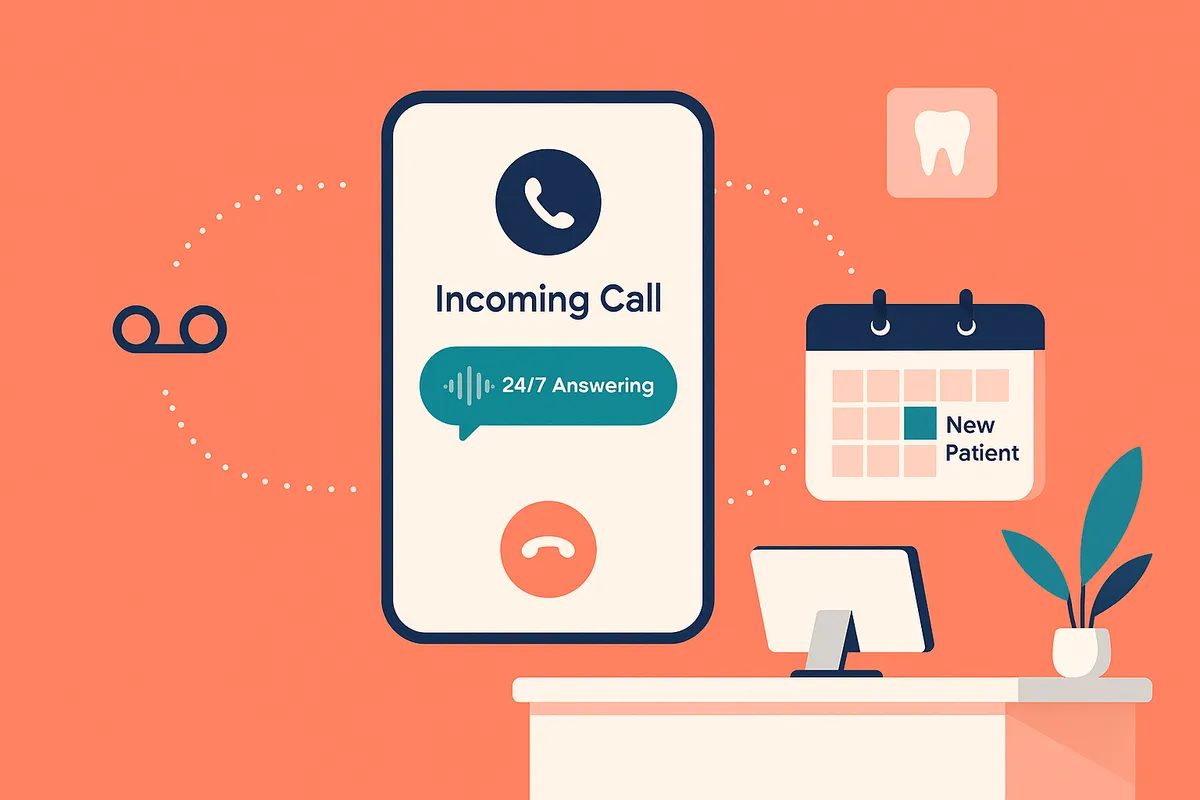
Voicemail has been the default after-hours answering solution for dental practices since the technology existed. It’s free, it’s familiar, and it works — in the narrow sense that it records a message if someone chooses to leave one.
The problem is that most patients don’t choose to leave one. And the ones who do often don’t answer when the practice calls back. Voicemail creates an illusion of coverage while patients quietly go elsewhere.
The shift away from voicemail toward AI answering isn’t happening because AI is trendy. It’s happening because practices are finally measuring what voicemail actually costs them — and the number is larger than most expected.
The Voicemail Problem by the Numbers
Let’s be specific about what happens when a dental practice relies on voicemail for after-hours, overflow, and busy-period calls.
80%+ of callers don’t leave voicemails. This is the statistic that changes the conversation. The vast majority of patients who reach voicemail hang up without leaving a message. They’re not lazy — they’re realistic. They know that leaving a voicemail initiates a game of phone tag that might take days to resolve. They call the next practice instead.
Voicemails that are left have low callback conversion. Of the 20% who do leave a message, many don’t answer when the practice calls back. The callback might come hours or a full day later — by which time the patient has made other plans, booked elsewhere, or lost the motivation that prompted the original call.
After-hours calls represent 30-40% of total call volume. Dental practices are closed 12-16 hours per day. A significant portion of patient call attempts happen during those closed hours — evenings, early mornings, weekends, and closed days. Every one of those calls goes to voicemail in a voicemail-only setup.
The lifetime value of a lost new patient: $3,000-$4,200. A new patient retained for five years represents significant cumulative revenue. Every new patient call that goes to voicemail and doesn’t convert represents that full lifetime value walking away.
The math: if a practice misses 15 new patient calls per month to voicemail, and 80% don’t leave messages, that’s 12 patients per month who hung up. If even 30% would have booked with a live answer, that’s 3-4 lost patients per month — $9,000-$16,800 per month in lifetime value, gone.
Why Patients Hate Voicemail
The patient perspective on voicemail is less about the technology and more about what it communicates.
It Signals Unavailability
When a patient calls and gets voicemail, the immediate message is: “We’re not here for you right now.” For new patients who have no existing relationship with the practice, this is a significant negative signal. They’re choosing a dental home — a practice that can’t answer the phone doesn’t inspire confidence.
It Creates Uncertainty
Voicemail asks the patient to trust that someone will listen, someone will call back, and the callback will happen at a convenient time. That’s a lot of trust to place in a practice the patient has never visited.
By contrast, a system that answers immediately, resolves the question, and books an appointment during the call provides certainty. The patient hangs up knowing their appointment is confirmed — not hoping someone will return their call tomorrow.
It Adds Friction to Simple Tasks
Most after-hours calls are simple: “I need to book a cleaning.” “I need to reschedule my appointment.” “Do you accept my insurance?” These are tasks that take 60-90 seconds with a responsive system. Voicemail turns them into multi-day processes.
What’s Replacing Voicemail
The replacement isn’t another message-taking system. It’s AI answering that resolves the patient’s need during the call.
GetHelpdesk.AI answers calls in under one second — after hours, on weekends, on closed days, during lunch breaks, and when the front desk is already on another call. The AI has a natural conversation, understands what the patient needs, and takes action.
Direct Appointment Booking
The most important capability: the AI books appointments directly into the practice management system. The patient calls at 8 PM on a Saturday, the AI checks real-time availability in the PMS, and the appointment is booked before the call ends. No message. No callback. No phone tag.
This is the fundamental difference between voicemail and AI answering. Voicemail collects information. AI answering resolves the patient’s need.
Practice-Specific Answers
The AI is configured with the practice’s specific information — insurance accepted, providers and their specialties, hours, location, what to expect at a first visit. Patients calling with questions get accurate answers immediately, rather than “leave a message and someone will get back to you.”
Multi-Language Support
For practices in diverse markets, AI answering in 25+ languages means patients who wouldn’t leave an English-language voicemail can have a complete conversation in their preferred language. This alone expands the accessible patient pool for many practices.
Emergency Triage
After-hours calls include genuine emergencies. Voicemail handles these identically to routine booking requests — a recording. AI can identify emergency situations from the conversation and route appropriately: on-call provider notification, next-day priority booking, or directing the patient to an emergency facility.
The Transition: What Practices Experience
Practices that switch from voicemail to AI answering typically report a specific sequence of results.
Week 1-2: The first surprise is volume. Practices discover they were getting more after-hours calls than they realized — because voicemail doesn’t surface the 80% who hang up. AI answering captures the full picture.
Month 1: Schedule density improves. Appointments booked after hours and on closed days fill gaps that used to appear on Monday mornings. Staff arrives to a schedule that’s already partially complete.
Month 2-3: New patient numbers increase. The patients who previously called, reached voicemail, and went elsewhere are now booking. This represents net new patients who were invisible in the voicemail model.
Ongoing: Front desk workload decreases. The morning voicemail callback backlog disappears. Phone tag decreases. Staff spend less time chasing patients and more time serving the ones in front of them.
Traditional Answering Services vs. AI
Some practices moved from voicemail to human answering services as an intermediate step. These services use operators who answer calls and take messages — better than voicemail, but still a message-taking model at the core.
The key differences:
| Voicemail | Human Answering Service | AI Answering (GetHelpdesk.AI) | |
|---|---|---|---|
| Answers calls | No (records) | Yes (human) | Yes (AI, instant) |
| Takes messages | Yes | Yes | Yes (plus transcripts) |
| Books appointments | No | No (can’t access PMS) | Yes (direct PMS integration) |
| After-hours cost | Free | $1.50-$4.00/minute | Flat monthly |
| Wait time | None (goes to recording) | 15-30 seconds | Under 1 second |
| Consistency | N/A | Varies by operator | Identical every call |
| Languages | English greeting only | Limited | 25+ automatically |
The critical line is “Books appointments.” Human answering services can’t access your PMS — they take a message that your staff follows up on. This makes them a better voicemail, not a replacement for an actual responsive system.
Key Takeaways
- Voicemail fails because 80%+ of callers don’t leave messages — the coverage it provides is illusory
- After-hours calls represent 30-40% of total call volume, all of which goes unresolved in a voicemail-only setup
- AI answering resolves the patient’s need during the call — booking appointments, answering questions, triaging emergencies
- The transition from voicemail to AI typically reveals more call volume than practices realized, and converts it into booked appointments
- Human answering services are better than voicemail but still can’t book into your PMS — they’re a message-taking model, not a resolution model
Frequently Asked Questions
Is voicemail still appropriate for any dental practice use case? Voicemail still has a role for calls that genuinely require human follow-up — complex billing disputes, lab coordination, specialist referrals. But for the primary after-hours use case (patients calling to book or ask routine questions), it should be replaced with a system that actually resolves those needs.
How much does it cost to switch from voicemail to AI answering? GetHelpdesk.AI operates on a flat monthly subscription. There’s no per-call or per-minute charge. Most practices find the cost is a fraction of the revenue they recover from captured after-hours bookings.
What if we’re already using an answering service? Many practices switch from human answering services to AI answering because the answering service can’t book appointments. The AI handles the resolution; if there are calls that genuinely need human routing, it handles that too.
How do patients react to the change? Patients don’t react to the absence of voicemail — they react to the presence of an immediate, helpful response when they call. The feedback is overwhelmingly positive because the experience is better.
Can we keep voicemail as a backup? Yes. Many practices configure AI answering as the primary system with voicemail as a final fallback for rare edge cases where the AI routes to a recording. In practice, this fallback is rarely triggered.
Voicemail had its era. Book a demo to see what replaces it — and what it does for your schedule.
Related Posts
10 Signs Your Dental Practice Needs an AI Answering Service
Not sure if AI answering is right for your practice? These 10 signals — from missed calls to Monday morning voicemail backlogs — tell you the answer.
AI 101 for Dentists: A Plain-Language Guide to What It Is and What It Does
Artificial intelligence sounds complicated until you see what it actually does at a dental practice. This guide explains the concepts that matter — and skips the ones that don't.
AI Answering Service for Dental Practices: The Complete Guide
Everything dental practice owners need to know about AI answering services — how they work, what they cost, what to look for, and how they compare to traditional solutions.