
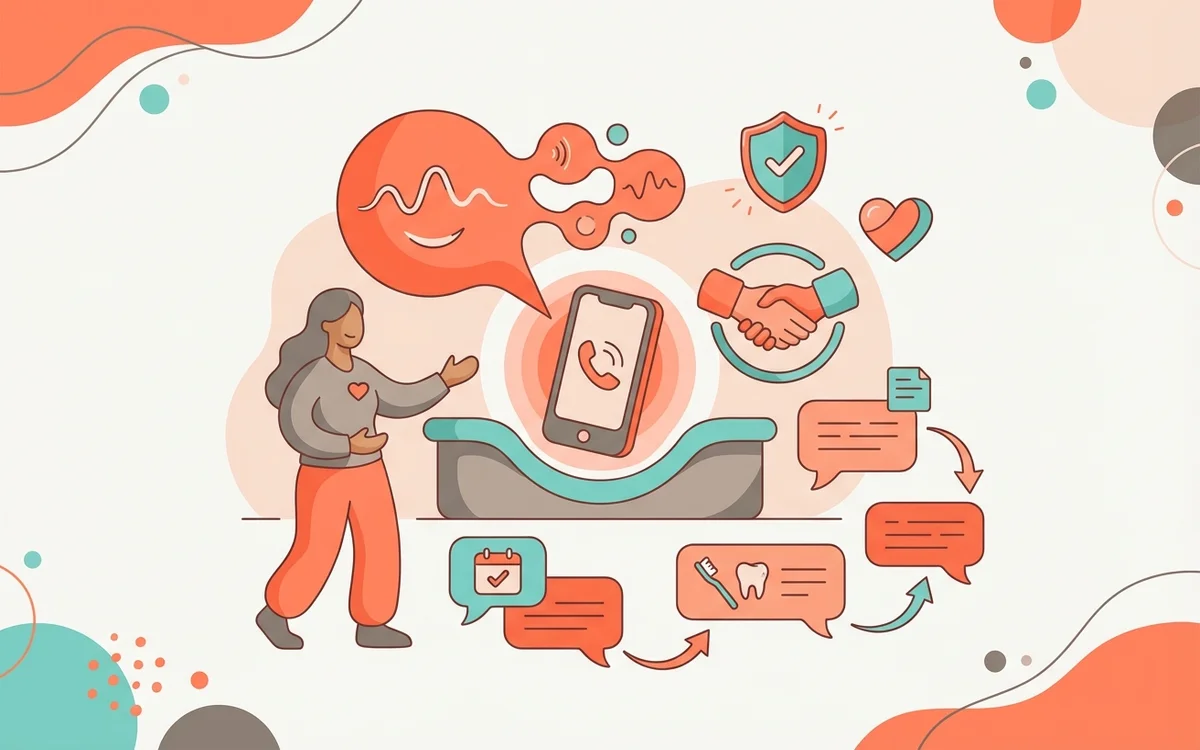
Can AI Build Trust? In Healthcare, It Must.
In healthcare—and especially in dental care—trust is everything. It’s what makes a nervous patient return for a follow-up visit. It’s what encourages someone to follow treatment recommendations. It’s what drives positive word-of-mouth and long-term loyalty.
So, when dental practices introduce AI receptionists into the patient experience, a natural question arises: Can patients really trust a robot with their care?
The short answer: Absolutely—if it’s done right.
According to Harvard Medical School research, trust in healthcare is built through three primary factors: competence, communication, and caring. AI, when implemented thoughtfully, can enhance all three.
AI isn’t meant to replace empathy or the human touch. It’s meant to enhance reliability, consistency, and accessibility, allowing your staff to shine in the moments that matter most. With a thoughtful implementation, an AI receptionist like GetHelpdesk.ai can actually become a trusted digital ally for your patients—and a powerful asset to your practice.
5 Ways AI Receptionists Build Patient Trust
Trust isn’t built overnight; it’s earned through repeatable, reliable, and respectful interactions. Here’s how AI helps your practice deliver exactly that:
1. Reliability and Consistency—Every Single Time
Human error is, well, human. Busy days can lead to:
- Rushed calls where important details get missed
- Forgotten messages that fall through the cracks
- Inconsistent information given to different patients
- Long hold times when multiple calls come in simultaneously
But an AI receptionist never gets tired, distracted, or overwhelmed.
With GetHelpdesk.ai, patients receive clear, accurate, and professional communication every single time—no matter the hour or the day. Whether they’re asking about office hours, insurance, or scheduling, they get the right answer on the first try.
That level of predictability builds trust.
When patients know they can rely on getting accurate information, they develop confidence in your entire operation. One study by Accenture Healthcare found that 83% of patients say consistent experiences significantly impact their trust in a healthcare provider.
2. Always Available = Always Reliable
Modern patients don’t live 9-to-5 lives. They want to:
- Book appointments at 10 PM after putting kids to bed
- Check insurance information on Sunday before Monday’s appointment
- Get reassurance about procedures during anxious late-night moments
- Handle dental matters during lunch breaks without long hold times
Your AI receptionist can be there for them 24/7, ensuring they always feel heard—even when your office is closed.
The psychology of availability:
- Being available when patients need you signals that you prioritize their needs
- Quick responses reduce anxiety (especially for nervous dental patients)
- No voicemail = no wondering if the message was received
That kind of round-the-clock accessibility gives patients confidence that your practice is committed to their needs. And confidence breeds trust.
3. Safe Space for Sensitive Conversations
Some patients hesitate to ask questions or share concerns with a person—especially when it involves:
- Billing and payment difficulties
- Insurance confusion
- Embarrassment about dental health
- Anxiety about procedures
- Questions they think are “stupid”
For these patients, AI provides a judgment-free zone to ask questions discreetly and get information without feeling self-conscious.
Why this matters:
A patient embarrassed about their dental hygiene might not ask a human receptionist for advice on bad breath—but they’ll ask an AI. A patient struggling financially might be more honest about payment concerns with AI than with a person they’ll see at their next visit.
By giving patients an option to communicate in a way that feels less intimidating, your practice becomes more approachable and inclusive. That openness lays the groundwork for deeper, more honest relationships.
4. Frees Up Time for Meaningful Human Interactions
The goal of AI isn’t to replace human interaction—it’s to protect and prioritize it.
By automating:
- Routine appointment scheduling and confirmations
- Frequently asked questions
- Reminder calls and follow-ups
- Basic insurance inquiries
GetHelpdesk.ai gives your front office staff more time to focus on complex, emotional, and high-value conversations.
What this looks like in practice:
| Without AI | With AI |
|---|---|
| Staff rushes through phone calls | Staff has time for thoughtful conversations |
| Patients wait on hold | Patients reach you immediately |
| Complex issues get superficial attention | Complex issues get focused care |
| Staff seems stressed and distracted | Staff seems calm and attentive |
When patients aren’t rushed or left on hold, they feel seen, heard, and cared for. It’s those personal moments that create lasting trust.
For more on reducing staff burden, see our post on dental staffing solutions.
5. Transparency and Choice Respect Patient Autonomy
Trust also depends on transparency. Patients should always:
- Know when they’re interacting with AI
- Have the option to speak with a real person
- Understand how their information is being used
- Feel in control of their communication preferences
GetHelpdesk.ai is built on clear disclosures and seamless handoffs to live staff when needed.
Our approach:
- AI identifies itself appropriately at the start of interactions
- Patients can request human assistance at any time
- Complex or sensitive matters are automatically escalated
- HIPAA-compliant data handling is standard
By respecting patient autonomy, you show that your practice values their preferences—whether they prefer digital efficiency or human connection. This choice itself builds trust.
Two Scripts to Steal
Everything above is a principle. Principles don’t get spoken on a phone call — words do. And the two moments that decide whether a patient trusts your AI are both about twelve words long: the moment it introduces itself, and the moment someone asks for a human.
Most practices never write these lines down. They accept a vendor’s default, hear it for the first time on a live patient call, and then wonder why the transfer rate is high. Write them yourself. They take ten minutes and they set the tone for every call your practice receives.
Script 1: The disclosure
Said at pickup, before anything else. It has three jobs: identify the practice, say plainly that this is not a person, and offer the way out in the same breath.
“Hi, thanks for calling [Practice Name]. I’m the practice’s virtual receptionist. I can help with booking, or I can pass your request to the team.”
That’s the whole thing. Nineteen words. Note what it does:
- “Virtual receptionist” is honest without being clinical. It doesn’t hide behind a human name, and it doesn’t announce “AI-POWERED VOICE ASSISTANT” like a product demo.
- “I can help with booking” sets an accurate expectation of scope, so the caller doesn’t waste ninety seconds on something the AI was never going to finish.
- “Or I can pass your request to the team” gives the exit before the caller has to ask for it. Offering the door unprompted is what makes people stop looking for it.
After-hours variant — the caller needs to know why they’re getting this and when a person is available:
“Hi, thanks for calling [Practice Name]. The office is closed right now. I’m the practice’s virtual receptionist — I can book you in, answer questions, or take a message for the team first thing tomorrow. If this is a dental emergency, say ‘emergency’ and I’ll get you the on-call number.”
Outbound variant — for confirmations and reminders, where the caller didn’t choose to talk to you:
“Hi, this is an automated call from [Practice Name] about your appointment on [day]. I’m a virtual assistant — you can talk to me normally, or say ‘office’ and I’ll connect you.”
What not to say:
- A human first name with no qualifier. “Hi, this is Rachel from Smile Dental” is the one choice that reliably damages trust, because the patient will figure it out and then wonder what else was staged.
- “How may I direct your call?” before disclosing. Never let a caller share something personal under the impression they’re talking to staff.
- Anything longer than about twenty-five words. Long greetings get interrupted, and the disclosure is the part that gets cut off.
Script 2: The human request
The second script fires whenever the caller says any version of “let me talk to a person.” Treat that phrase as an instruction, never as an objection to overcome. One attempt to keep the caller in the AI flow undoes the entire disclosure.
During office hours:
“Of course — let me get someone from the team. One moment.”
Four seconds. No qualifying question, no “I can probably help with that,” no explanation of what it’s capable of. The caller asked for a person; give them a person.
During office hours, when the line is busy:
“Of course. Everyone’s with a patient right now — I can hold your place and have them call you back within [X], or I can keep you on the line. Which would you rather?”
The honesty matters more than the outcome. You’re telling them the truth about the wait and letting them choose, which is the same respect for autonomy that made the disclosure work.
After hours:
“Of course. The office is closed right now, but I’ll make sure the team calls you back when we open at [time]. Can I take your name, number, and what you’d like to talk about? And if this is urgent — pain, swelling, or an injury — say ‘emergency’ and I’ll get you the on-call number right now.”
What not to say:
- “I can help you with that!” after a request for a human. This is the single most trust-damaging line an AI receptionist can deliver.
- “Are you sure?” or any confirmation step.
- Asking why they want a person.
- Repeating the disclosure. They already know; that’s why they’re asking.
Make the handoff carry context
The script is only half the handoff. What makes patients trust the transfer is not having to start over. Whoever picks up — now or on the callback — should already have the caller’s name, number, what they asked for, and how far the AI got.
When a patient has to re-explain their situation to the second person, the AI didn’t transfer them. It just delayed them. GetHelpdesk.ai passes the full call context to your team on every escalation, which is why practices see the transfer land as a continuation rather than a restart. How AI hands difficult calls to your team documents what that context payload contains. The same pattern applies whether you’re running a general practice or an orthodontic front desk, where consult calls and treatment-in-progress questions escalate more often.
Test both scripts before you go live
Call your own main line three times: once during hours, once after close, and once asking for a person in the first five seconds. Listen for whether the disclosure survives the caller talking over it, and whether the human request gets honored on the first ask.
If either script makes you wince as a patient, rewrite it now. It’s much cheaper than rewriting it after four hundred patients have heard it.
What Patients Actually Say About AI Receptionists
Real feedback from patients at practices using GetHelpdesk.ai:
“I was skeptical at first, but being able to schedule my appointment at midnight when I remembered was amazing. I used to forget to call during work hours.”
“It knew my name and my upcoming appointment. That felt more personal than some human interactions I’ve had.”
“I appreciate that I could ask about costs without feeling judged. When I needed to talk to a person about my payment plan, the transfer was seamless.”
“I’m an anxious patient. Being able to get information without having to make a phone call actually helped me finally book that appointment I’d been putting off.”
Building Trust Is a Journey—And AI Can Walk It With You
Trust doesn’t come from a single touchpoint. It’s built over time, through small but meaningful interactions that demonstrate:
- Consistency in every communication
- Care for patient needs and preferences
- Respect for patient time and autonomy
An AI receptionist like GetHelpdesk.ai supports that journey by ensuring:
- Every call is answered promptly
- Every message is accurate and helpful
- Every patient feels acknowledged
It doesn’t replace your humanity—it strengthens it by giving you more capacity to be human when it matters most.
Key Takeaways
- Trust is built through consistency—AI delivers the same quality every time, building patient confidence
- 24/7 availability shows patients you’re committed to their needs
- Judgment-free AI interactions help anxious patients ask questions they might avoid with humans
- Automation frees staff for the personal interactions that build deep relationships
- Transparency and choice respect patient autonomy and earn their confidence
- Write the two scripts yourself — the disclosure at pickup and the response to a human request decide more about trust than any other setting
Frequently Asked Questions
What exactly should the AI say when it answers?
A disclosure that does three things in one breath: names the practice, says plainly that this isn’t a person, and offers the exit before the caller has to ask. “Hi, thanks for calling [Practice Name]. I’m the practice’s virtual receptionist. I can help with booking, or I can pass your request to the team.” Keep it under about twenty-five words — longer greetings get talked over, and the disclosure is the part that gets cut off.
What should happen when a caller asks for a human?
The transfer, immediately and without a qualifying question. “Of course — let me get someone from the team. One moment.” Never answer a request for a person with “I can help you with that” — one attempt to keep the caller in the AI flow undoes the trust the disclosure built. After hours, take the callback details and offer the emergency path.
Won’t patients feel they’re getting worse service from AI?
Most patients actually prefer AI for routine matters—it’s faster and doesn’t put them on hold. What matters is that AI enhances their experience for simple tasks while humans remain available for complex needs. The key is implementation: AI should feel helpful, not like a barrier.
How do we introduce AI without making patients feel depersonalized?
Communication is key. Explain the benefits: “We’ve added a new system so you can reach us 24/7 and get instant answers.” Emphasize that human staff is always available. Frame it as an addition, not a replacement.
What about older patients who might be uncomfortable with technology?
Our AI is designed to be intuitive—patients interact through phone calls, not apps. For patients who prefer human interaction, the AI smoothly transfers to staff. Most practices find that even older patients appreciate not waiting on hold.
Does AI really build trust, or just convenience?
Both—and they’re connected. Trust is built when patients can rely on your practice. Convenient, consistent experiences create that reliability. When patients know they can always reach you and always get accurate information, trust naturally follows.
How do we measure whether AI is helping or hurting trust?
Track patient satisfaction scores, review feedback, and monitor patient retention. GetHelpdesk.ai provides analytics on call resolution, transfer rates, and patient sentiment. Most practices see satisfaction scores improve within months of implementation. Turning that sentiment into public review volume is covered in how AI improves dental reviews and reputation.
Discover the AI That Patients Trust
Ready to transform your front office into a trust-building engine—without sacrificing professionalism, accessibility, or compassion?
👉 Book a demo of GetHelpdesk.ai and see how our AI receptionist can become a dependable, trustworthy extension of your team.
The future of patient communication isn’t just efficient—it’s empathetic, accessible, and aligned with modern care values.
Earn trust with every conversation. Build loyalty with every interaction. Do it all with GetHelpdesk.ai.
Related Posts
Will Patients Be Annoyed If AI Answers?
Pew found 56% want to be told about AI scheduling versus 81% for AI diagnoses, and 63% want more say. What the 2026 surveys mean for AI answering your phone.

Scheduling the Orthodontic Patient Journey
"I want braces" can mean a consultation, a records visit or the start. How to map the orthodontic patient journey to the right appointment types by phone.

Covering Calls on a Closed Dental Weekday
On a closed weekday, answer, give the real next opening, book into a working day and route anything urgent. How to cover dental calls when you are shut.