
Comparing Costs: Full-Time Receptionist vs AI Answering Assistant
A dental receptionist books appointments, answers calls, handles questions and keeps patients moving through the office. With overheads rising, it is fair to ask what that position costs against an AI Answering Assistant. This page works through the numbers using published US Bureau of Labor Statistics (BLS) data and our own flat price, and it says plainly where the two are not doing the same job.
The figures below are the salary arithmetic. If you are weighing an actual hiring decision, should you hire a receptionist or use AI covers the costs this page leaves out: time to hire, the ramp to competence, turnover, and the hours a salaried person structurally cannot cover.
The AI covers the phones. It does not greet patients at the desk or have difficult conversations in person, so treat the comparison as the cost of phone coverage against the cost of a salaried hire, not as a like-for-like swap.
The True Cost of a Full-Time Receptionist
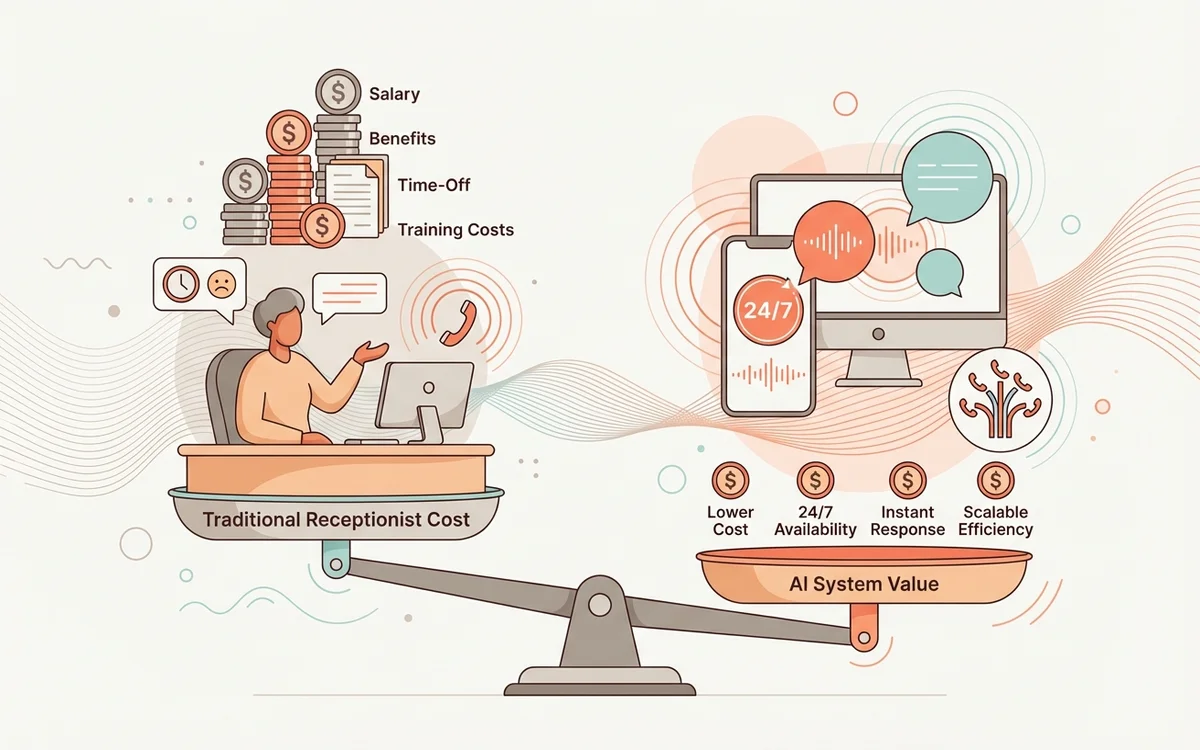
When you budget for a full-time receptionist, you’re looking at far more than just their salary. The comprehensive cost includes:
- Salary: The BLS puts the median pay for receptionists at $38,010 a year ($18.27 an hour) as of 2025. Your local market, and dental offices specifically, may sit above or below that.
- Benefits: Health insurance, retirement contributions and paid time off. In the BLS Employer Costs for Employee Compensation release for June 2026, benefits made up 30.0% of private-industry compensation costs, which is about 43 cents for every dollar of wages. A small practice may offer less than that average, or more.
- Taxes & Contributions: Employer-paid Social Security, Medicare (FICA), unemployment insurance (SUTA/FUTA) and workers’ compensation are mandatory. The BLS benefits figure above already counts the legally required share.
- Recruitment & Training: Advertising the position, interviewing, background checks, and the time spent training a new hire. The BLS expects about 105,100 receptionist openings a year through 2035, almost all of them from people leaving the job or retiring, so budget for turnover as well as for one hire.
- Office Space & Equipment: A desk, chair, computer, phone system, and associated utilities all contribute to the overhead.
- Breaks & Downtime: Human employees require breaks, lunch, and can experience illness, leading to periods of reduced or no productivity.
- Management Time: The time spent by practice owners or managers on supervision, performance reviews, and HR-related tasks.
- Fatigue at peak times: Even a good receptionist is on one call at a time, and the phone competes with the patient standing at the desk.
For the AI side of that comparison as a plain monthly figure, with the first-year arithmetic, see what a dental AI receptionist costs.
The Cost-Effectiveness of an AI Answering Assistant
In stark contrast, an AI Answering Assistant presents a lean and highly efficient cost model:
- Subscription Fee: GetHelpdesk.AI is $399 a month, flat, month to month, which is $4,788 over twelve months. The plan includes up to 600 inbound calls a month, outbound calling, SMS follow-ups, a website chatbot that books, reschedules and cancels into your practice management system, and a dashboard of every call. There are no benefits, payroll taxes or recruitment costs on top.
- 24/7 Availability: The AI answers around the clock, 365 days a year, without overtime pay, sick days or holidays, including the evenings and weekends a salaried person is not there to cover.
- Scalability: The AI can take several callers at once, which would take multiple receptionists at peak times.
- Short Start-Up: A typical go-live is five to seven days from kickoff, with guided setup and staff training included, and updates are handled by us as part of the subscription.
- Consistent Performance: The AI does not tire during a busy Monday, and every call comes back as a transcript and summary you can review.
- Your team keeps the work that needs a person: With routine calls handled, staff can spend their time on patients in the chair, treatment plans and complex conversations.
The Annual Arithmetic
| Cost line | Full-time receptionist | GetHelpdesk.AI |
|---|---|---|
| Pay or subscription | $38,010 (BLS median pay, 2025) | $4,788 ($399 x 12) |
| Benefits and employer taxes | About $16,300 (the BLS private-industry average of 43 cents per wage dollar) | Included |
| Total, before recruitment and management time | About $54,300 | $4,788 |
The benefits line applies the June 2026 BLS private-industry average to the median wage ($38,010 x 14.07 / 32.82). It is a reference point, not a quote for your practice. Your own wage, benefit package and state will move it, so substitute your numbers.
Not priced in the table: recruiting, training time, desk and equipment, management time, and the cost of repeating the hire when someone leaves. Those all push the receptionist column up, and none of them apply to the AI column.
The two columns also do different work. A receptionist covers about forty hours a week and the whole front desk. The AI covers the phone at every hour. If you need both, the useful question is what the $399 buys in calls you currently miss, and the missed-call audit is how to find out.
The GetHelpdesk.AI Advantage
For most practices the AI is an addition to the front desk. It answers the calls that arrive when your team is busy or the office is closed, and it leaves your people free for the care and personal connection that distinguish your practice. It is DSO compatible, so the same approach works across locations.
Cost is only one of five questions that decide this. The best virtual receptionist for a dental practice works through the other four and maps each practice profile to the option that fits it.
Want the arithmetic on your own numbers?
Book a demo with GetHelpdesk.AI and we will work through your call volume, missed-call rate and case value with you. Return on a $399 plan depends on those three inputs and can range from roughly 10x to 50x, so it is worth calculating with your own figures.
Sources
- Receptionists, Occupational Outlook Handbook, U.S. Bureau of Labor Statistics: median pay $38,010 a year ($18.27 an hour) in 2025; about 105,100 openings a year projected through 2035; employment projected to decline 2 percent
- Employer Costs for Employee Compensation, June 2026, U.S. Bureau of Labor Statistics, released September 9, 2026: private-industry wages and salaries $32.82 an hour (70.0%), benefits $14.07 (30.0%)
- Pricing, GetHelpdesk.AI
Related Posts
AI Receptionist Buyer's Guide for Dentists
Test two matters most: book during the call, then open your own PMS and check the appointment. Five tests, contract terms and a scorecard for dental buyers.
How AI Receptionist Pricing Actually Works
Pull four numbers from last month's call log and price every quote against them. Twenty minutes that makes AI receptionist pricing comparable.
AI Voice Agents for Dental Practices in 2026
How a dental AI voice agent differs from voicemail, IVR, chatbots and answering services, plus five test calls and a launch checklist to run before go-live.