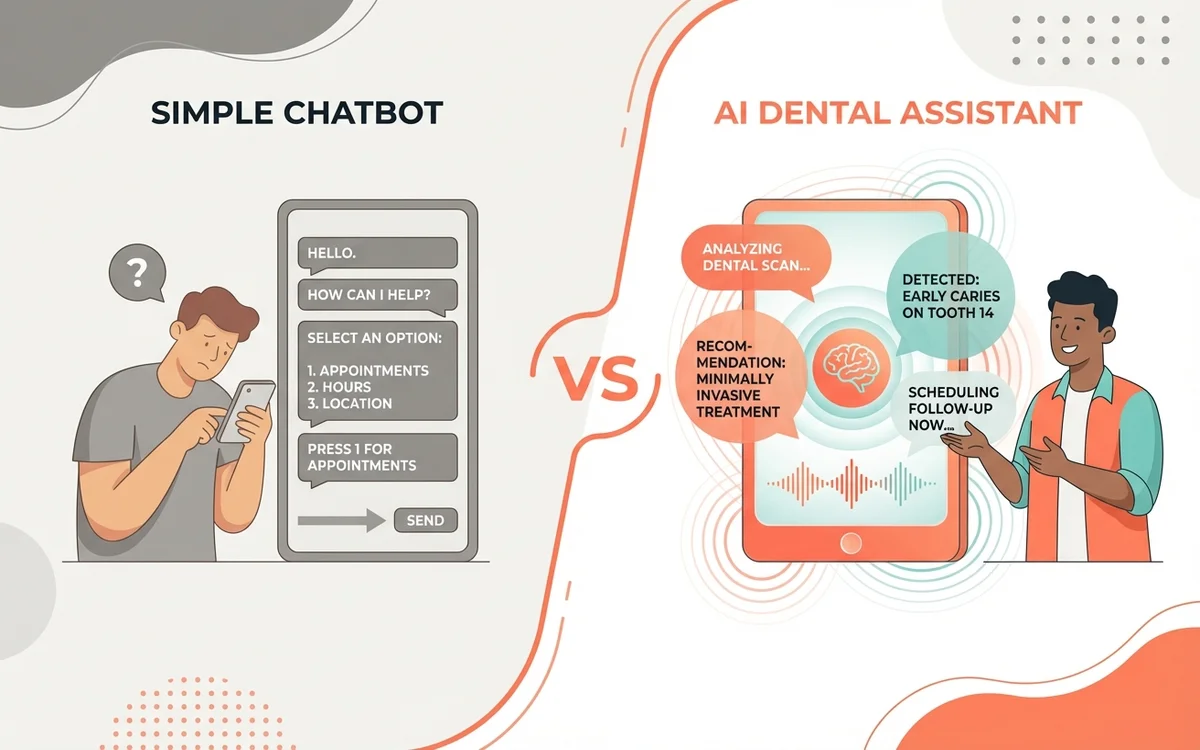
The term “AI” gets applied to everything from a simple FAQ chatbot on a website to a fully integrated phone system that books appointments into your practice management software. For dental practice owners evaluating these tools, the lack of distinction is confusing and expensive — because the differences in capability directly affect patient experience and practice revenue.
A chatbot and an AI receptionist solve fundamentally different problems. Understanding that difference prevents the common mistake of deploying the wrong tool and concluding that “AI doesn’t work for our practice.”
What a Chatbot Actually Does
A chatbot is a text-based interface — typically embedded on a website or available through messaging platforms — that responds to typed questions with pre-configured answers.
Most dental chatbots operate on one of two models:
Rule-based chatbots follow scripted conversation trees. The patient clicks “Book an appointment” and gets a predefined series of questions. Any deviation from the script produces a “I’m sorry, I didn’t understand that” response or a redirect to “call the office.”
FAQ chatbots match patient questions to a library of answers using basic keyword matching. “What insurance do you accept?” returns the insurance answer. “Do you take Delta Dental?” might return the same answer — or might fail because “take” isn’t in the keyword set.
Both types are text-only, website-only, and limited to a narrow set of pre-configured interactions. They can’t make phone calls, book into a PMS, or handle the unexpected turns that real patient conversations take.
What Chatbots Are Good For
Within their limitations, chatbots have legitimate uses:
- Providing basic office information (hours, address, phone number) to website visitors
- Answering the same 5-10 FAQs repeatedly
- Collecting contact information for follow-up
- Pre-qualifying website leads for staff callback
What Chatbots Can’t Do
- Answer phone calls
- Have dynamic, multi-turn conversations
- Book appointments directly into your PMS
- Handle patient requests that fall outside the script
- Operate in languages other than their configured language
- Triage emergencies appropriately
- Adapt to how individual patients communicate
What an AI Receptionist Actually Does
An AI receptionist is a voice-based system that answers phone calls, understands natural language, has fluid conversations, and takes actions — primarily booking appointments into your practice management system.
The technology foundation is fundamentally different from a chatbot. An AI receptionist uses:
- Natural language processing (NLP) to understand what patients mean, not just what words they say
- Speech recognition to convert spoken language to text in real time
- Conversational AI to manage multi-turn dialogues with context awareness
- PMS integration to read real-time availability and write confirmed appointments
- Multi-language models to handle calls in the patient’s preferred language automatically
The result is a system that handles the actual phone interactions that drive practice revenue — not just website browsing behavior.
The Practical Differences That Matter
Phone vs. Web
This is the most important distinction. Dental patients still call. Despite the growth of online booking, phone calls remain the primary way patients interact with dental practices — especially for new patient inquiries, urgent needs, and complex scheduling situations.
A chatbot handles website visitors. An AI receptionist handles phone callers. These are largely non-overlapping patient populations. The patients who call (especially after hours and for high-value inquiries) are often higher-intent than web browsers.
Resolution vs. Collection
A chatbot collects information — names, phone numbers, questions — and passes them to a human for resolution. The patient still waits for a callback.
An AI receptionist resolves the patient’s need during the interaction. The appointment is booked. The question is answered. The call ends with the patient’s need fulfilled, not deferred.
Dynamic Conversations vs. Scripts
Real patient phone calls don’t follow scripts. Patients interrupt, change topics, provide information out of order, and ask follow-up questions that branch the conversation in unexpected directions.
An AI receptionist handles these dynamics naturally because it’s processing language in real time, not matching against a conversation tree. A chatbot breaks when the patient deviates from the expected flow.
PMS Integration vs. Standalone
The most critical practical difference: can the system book appointments?
A chatbot can collect “I want to book a cleaning next Tuesday at 2 PM” and send that information somewhere. An AI receptionist checks your PMS, confirms the slot is available with the correct provider and room, books the appointment, and confirms it — all during the call.
This is the difference between a tool that creates work for your staff (follow-up booking) and one that eliminates work (the booking is already done).
When to Use Each
The right tool depends on the problem you’re solving:
Use a chatbot when:
- You want to provide basic information to website visitors
- You need a contact form replacement that feels more interactive
- Your primary concern is capturing web leads for staff follow-up
- You have minimal after-hours call volume
Use an AI receptionist when:
- You’re losing patients to missed calls and voicemail
- After-hours and closed-day coverage is a gap
- Your front desk is overwhelmed with phone volume
- You need appointments booked directly into your PMS
- You serve patients in multiple languages
- Phone conversion rate matters to your practice growth
Use both when:
- Your practice has significant web traffic AND phone volume
- Different patient segments prefer different communication channels
- You want comprehensive coverage across all touchpoints
The Cost-Value Comparison
Chatbot costs range from free (basic FAQ bots) to $50-$200/month for more sophisticated systems. AI receptionist costs are typically higher — reflecting the complexity of voice processing, PMS integration, and 24/7 phone coverage.
The value comparison, however, isn’t close. A chatbot might generate 5-10 contact form submissions per month on a practice website. An AI receptionist typically books 50-100+ appointments per month that would otherwise be lost to voicemail or missed calls.
At an average appointment value of $200-$400, the AI receptionist’s revenue impact is $10,000-$40,000+ per month. The chatbot’s impact — if staff follows up on leads promptly — is a fraction of that.
Key Takeaways
- Chatbots are text-based, website-only tools that collect information for human follow-up
- AI receptionists are voice-based systems that answer calls, have natural conversations, and book appointments into your PMS
- Phone callers (especially after-hours and high-intent) are a different and often more valuable patient population than website browsers
- The critical capability gap: chatbots create work (staff must follow up); AI receptionists resolve needs during the call
- Both tools have legitimate uses — they solve different problems for different patient behaviors
Frequently Asked Questions
Can a chatbot eventually replace an AI receptionist? Not for phone interactions. Chatbots are fundamentally text-based tools. Even as they become more sophisticated, they don’t address the phone-first behavior that drives most dental patient interactions.
Do I need to choose between a chatbot and an AI receptionist? No. They serve different channels and can operate simultaneously. A website chatbot handles web visitors; an AI receptionist handles phone callers.
Is an AI receptionist harder to set up than a chatbot? The configuration is more involved because it requires PMS integration, scheduling rule configuration, and practice-specific training. GetHelpdesk.AI handles this through a guided onboarding process — most practices are live within a week.
What about AI chat systems that handle text/SMS? Text-based AI systems (SMS, web chat) with PMS integration sit between chatbots and AI receptionists in capability. They handle text conversations with booking ability — useful for practices with high text volume, but not a replacement for voice answering.
How do I evaluate which is right for my practice? Look at where you’re losing patients. If it’s website visitors bouncing without contact, a chatbot helps. If it’s phone calls going to voicemail, you need an AI receptionist. Most practices have a phone problem, not a website problem.
The distinction matters because deploying the wrong tool means solving the wrong problem. Book a demo to see what an AI receptionist — not a chatbot — does for dental practices.
Related Posts
10 Signs Your Dental Practice Needs an AI Answering Service
Not sure if AI answering is right for your practice? These 10 signals — from missed calls to Monday morning voicemail backlogs — tell you the answer.
AI 101 for Dentists: A Plain-Language Guide to What It Is and What It Does
Artificial intelligence sounds complicated until you see what it actually does at a dental practice. This guide explains the concepts that matter — and skips the ones that don't.
AI Answering Service for Dental Practices: The Complete Guide
Everything dental practice owners need to know about AI answering services — how they work, what they cost, what to look for, and how they compare to traditional solutions.