
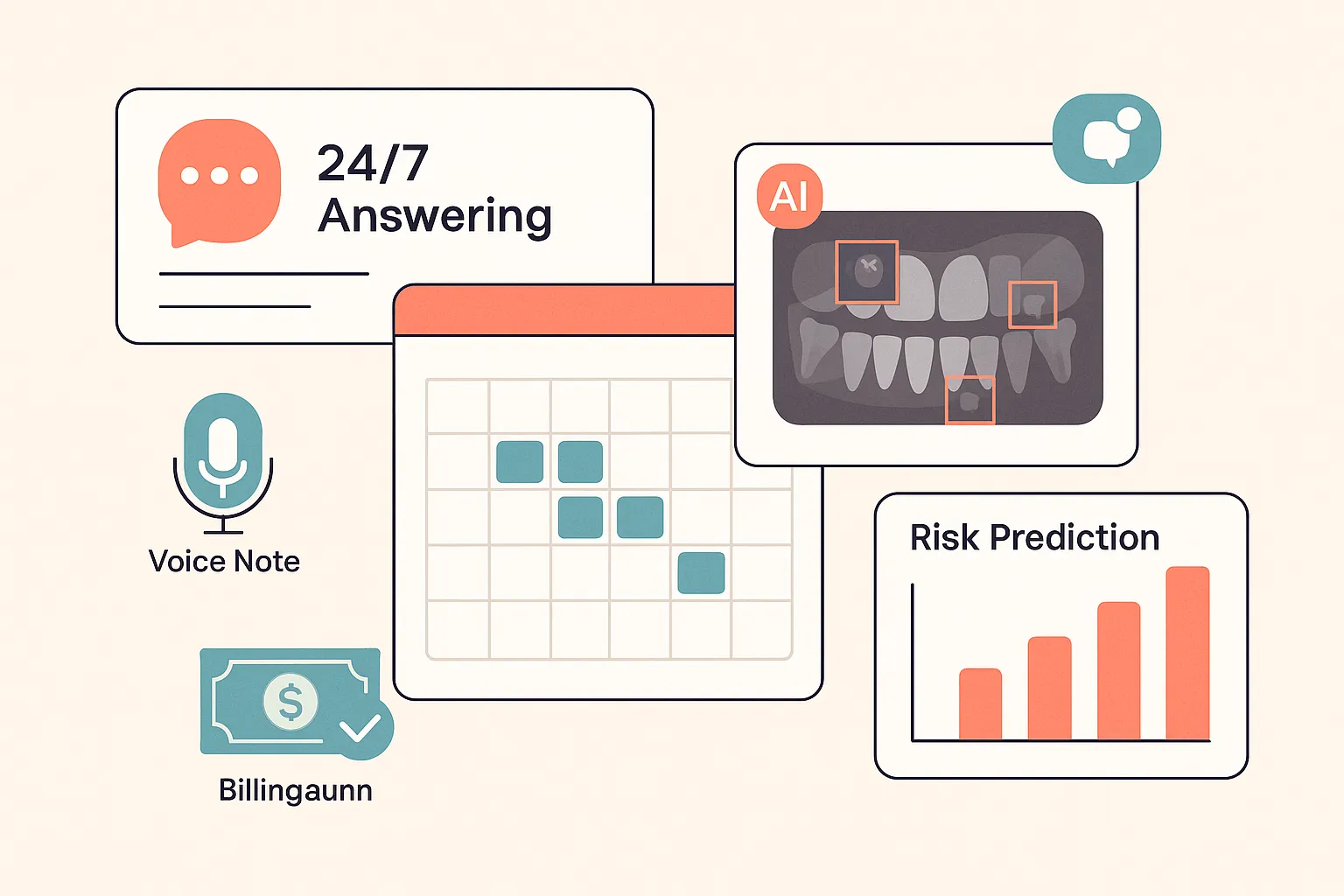
The AI Revolution in Dentistry Is Here
Artificial Intelligence (AI) is reshaping the healthcare landscape, and dentistry is no exception. From smarter patient communication to predictive analytics and clinical decision support, AI offers powerful tools for modern dental practices. If you’re in the dental industry, understanding these trends can help you stay ahead and deliver superior care while boosting your operational efficiency.
According to Forbes’ healthcare technology report, global investment in healthcare AI reached $15 billion in 2024, with dental applications growing at 35% annually. The practices that adopt these technologies early are seeing measurable competitive advantages.
Here are the top AI trends in healthcare that every dental practice should watch in 2025:
1. AI-Powered Patient Communication
Patients today expect instant, 24/7 responses—and AI delivers just that. With AI tools like GetHelpdesk.ai, dental clinics can automate patient queries, schedule appointments, send reminders, and handle FAQs with ease.
Why It Matters for Dental Practices
Operational benefits:
- Reduces front desk workload by 60-70%
- Improves patient satisfaction with instant responses
- Minimizes missed appointments through automated reminders
- Enables after-hours support without extra staffing costs
Patient experience benefits:
- No more waiting on hold
- Schedule appointments at 10 PM or on weekends
- Get instant answers to common questions
- Receive appointment reminders via preferred channel
The data is compelling: practices using AI communication tools see 90%+ call answer rates compared to 65-70% without AI. That translates directly to more new patients captured and better retention.
Learn more about why clinics are investing in conversational AI.
2. Predictive Analytics for Patient Care
AI can analyze patient history and trends to predict future dental issues, helping dentists take preventive measures. By leveraging predictive analytics, dental practices can shift toward more preventive models of care—improving patient outcomes while establishing more stable recurring revenue streams.
Real-World Applications
Risk assessment:
- Predicting which patients are at high risk for periodontal disease based on past visits, lifestyle data, and oral hygiene habits
- Identifying patients likely to miss appointments based on historical patterns
- Flagging patients overdue for preventive care
Treatment planning:
- Recommending preventive treatments before issues become serious
- Personalizing recall intervals based on individual risk profiles
- Optimizing treatment sequences for better outcomes
Benefits for Your Practice
- Enhances patient outcomes through early intervention
- Increases treatment plan acceptance with data-backed recommendations
- Supports personalized care that patients increasingly demand
- Creates opportunities for proactive outreach
3. AI in Diagnostic Imaging
AI-powered imaging tools are now capable of detecting cavities, infections, and bone loss more accurately than ever. These tools can flag early signs of disease that may be missed in traditional readings.
Current Capabilities
AI diagnostic systems can identify:
- Early-stage cavities before visible symptoms
- Periodontal bone loss patterns
- Cysts and lesions requiring attention
- Developmental abnormalities
- Root fractures and periapical pathology
Implications for Dental Clinics
Clinical benefits:
- Faster, more accurate diagnostics
- Reduced risk of missed findings
- Standardized screening across all patients
- Better documentation for treatment planning
Patient benefits:
- Reduced chair time for diagnostic procedures
- Improved trust through transparent imaging
- Earlier intervention means simpler treatments
- Visual explanations that aid understanding
While AI imaging is advancing rapidly, it’s designed to assist—not replace—clinical judgment. The dentist remains the final decision-maker.
4. Voice Recognition and Clinical Documentation
AI voice assistants are being integrated into dental software to transcribe notes, chart findings, and manage records in real time—all hands-free.
How It Works
Dentists and hygienists can speak naturally during exams:
- Dictate clinical findings directly into the patient record
- Complete charting without touching a keyboard
- Document treatment notes in real-time
- Update patient history conversationally
Time-Saving Impact
- Cuts documentation time by 40-60%
- Frees up focus for patient care during appointments
- Reduces clerical errors from rushed note-taking
- Enables more thorough documentation without adding time
For busy clinicians, this technology means fewer late nights catching up on charts and more complete records for every patient.
5. AI Chatbots for Website and Social Media
AI chatbots can engage visitors on your website or social channels, guiding them to book appointments or answer insurance-related queries instantly.
Beyond Basic FAQs
Modern AI chatbots can:
- Qualify new patient leads and capture contact information
- Answer complex insurance questions with practice-specific accuracy
- Guide patients through pre-appointment forms
- Schedule appointments directly from the website
- Provide post-procedure care instructions
- Collect feedback and reviews
Why Your Practice Needs One
Conversion impact:
- Converts web visitors into booked patients (vs. losing them to “I’ll call later”)
- Provides round-the-clock assistance matching patient schedules
- Captures leads even when staff isn’t available
Brand impact:
- Enhances professional presence
- Shows technological sophistication
- Builds trust through immediate responsiveness
Research shows that 53% of patients research practices online before booking. An AI chatbot ensures those visitors get immediate engagement.
6. Revenue Cycle Management and Billing Automation
AI tools are increasingly used to streamline insurance claims, billing, and collections—reducing errors and accelerating payments.
Current Applications
Claims processing:
- Automatic eligibility verification before appointments
- Smart claim submission with error detection
- Denial prediction and prevention
- Automated appeals for rejected claims
Billing optimization:
- Patient payment plan recommendations
- Collection timing optimization
- Outstanding balance follow-up automation
- Financial reporting and forecasting
How It Helps Your Front Office
- Faster claims processing and payment cycles
- Fewer denials and rejected claims
- Better cash flow management
- Reduced time spent on billing tasks
- Improved patient payment collection rates
Preparing Your Practice for AI Adoption
If you’re considering AI adoption, here’s a practical roadmap:
Phase 1: Patient Communication (Immediate)
Start with AI-powered answering and scheduling. This delivers immediate ROI with minimal disruption. Learn implementation tips.
Phase 2: Administrative Automation (3-6 months)
Add automated reminders, website chatbot, and billing assistance. Build on the foundation of Phase 1.
Phase 3: Clinical AI (6-12 months)
Explore diagnostic AI and voice documentation as the technology matures and integrations become seamless.
Throughout: Staff Training and Change Management
Technology adoption succeeds when your team embraces it. Invest in training and communicate the “why” behind each new tool.
Key Takeaways
- AI in patient communication delivers the fastest, most measurable ROI for dental practices
- Predictive analytics enable preventive care models that improve outcomes and revenue
- Diagnostic AI enhances clinical accuracy but requires human oversight
- Voice documentation saves significant clinician time
- Start with communication AI—it’s the foundation for broader digital transformation
- 2025 is the year to move from “watching AI” to “implementing AI”
Frequently Asked Questions
Is AI in dentistry just hype, or is it actually practical?
It’s very practical—especially in patient communication and administrative tasks. Hundreds of dental practices are already using AI answering services, chatbots, and reminder systems with measurable results. Clinical AI like diagnostic imaging is still emerging but advancing rapidly.
How much does it cost to implement AI in a dental practice?
Costs vary widely. Patient communication AI (like GetHelpdesk.ai) typically costs a fraction of a full-time employee. Diagnostic AI systems involve higher upfront investment but can improve diagnostic accuracy significantly. Start with communication AI for the best ROI.
Will AI replace dental staff?
No. AI handles routine, repetitive tasks so staff can focus on complex, high-value work that requires human judgment and empathy. Most practices using AI report improved staff satisfaction, not job losses.
What AI should a dental practice implement first?
Patient communication AI—answering services, scheduling, and reminders. This area has the most mature technology, fastest implementation, and clearest ROI. It also creates the foundation for other AI adoption.
How do I ensure AI meets HIPAA requirements?
Choose vendors specifically designed for healthcare. GetHelpdesk.ai and other reputable dental AI tools are built HIPAA-compliant from the ground up, including encryption, access controls, audit trails, and Business Associate Agreements.
Embrace AI to Future-Proof Your Dental Practice
AI is not just a buzzword—it’s a game-changer for dentistry. By adopting AI-powered tools like GetHelpdesk.ai, dental practices can reduce administrative burden, enhance patient satisfaction, and stay competitive in an evolving industry.
Whether you’re a front desk admin juggling patient calls or a dentist looking to boost diagnostic accuracy, these AI trends are worth watching—and implementing—in 2025.
👉 Ready to bring AI into your dental office? Try GetHelpdesk.ai to automate patient communication, reduce no-shows, and give your front office staff the support they deserve.
The future of dentistry is intelligent. Start building it today.
Related Posts
10 Signs Your Dental Practice Needs an AI Answering Service
Not sure if AI answering is right for your practice? These 10 signals — from missed calls to Monday morning voicemail backlogs — tell you the answer.
AI 101 for Dentists: A Plain-Language Guide to What It Is and What It Does
Artificial intelligence sounds complicated until you see what it actually does at a dental practice. This guide explains the concepts that matter — and skips the ones that don't.
AI Answering Service for Dental Practices: The Complete Guide
Everything dental practice owners need to know about AI answering services — how they work, what they cost, what to look for, and how they compare to traditional solutions.