
Your front desk is slammed. The phone keeps ringing. A new patient hears four rings, then voicemail — and hangs up.
That scenario plays out constantly. (Looking for a dental answering service that actually books appointments? Skip to our dedicated guide.) Dental practices miss roughly 32% of incoming calls during business hours. Annual revenue losses from missed calls can reach six figures, according to industry data from Arini.ai.
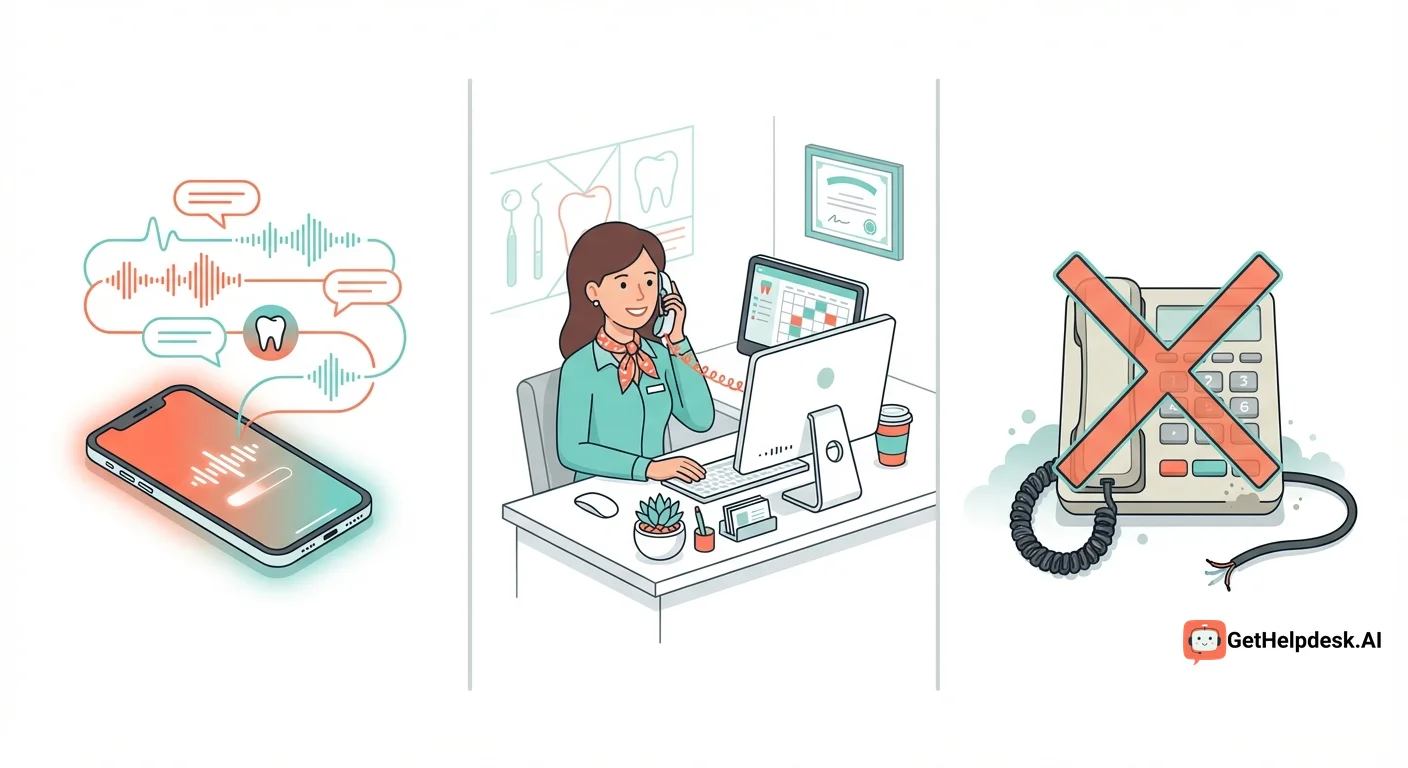
So what’s the best way to handle patient calls in 2026? You have three real options: AI answering services, human answering services, or voicemail. Each has genuine strengths and trade-offs.
This guide breaks down all three — with real costs, honest pros and cons, and a clear recommendation based on your practice size.
Side-by-Side Comparison
Here’s what matters most to practice owners, at a glance:
| Feature | AI Answering Service | Human Answering Service | Voicemail |
|---|---|---|---|
| Availability | 24/7/365 | Limited hours (or expensive 24/7) | 24/7 (recording only) |
| Response time | Instant (first ring) | 15–60 sec hold time | No live response |
| Appointment booking | Yes, real-time with PMS | Message-taking only | No |
| Cost per month | $299–$499/mo flat | $800–$2,500+/mo | $0–$25/mo |
| Handles patient questions | Yes (FAQs, insurance, directions) | Basic scripted responses | No |
| PMS integration | Yes | Rarely | No |
| Consistency | 100% — same quality every call | Varies by operator | N/A |
| Empathy for complex situations | Improving, but limited | Strong | None |
| Scalability | Unlimited concurrent calls | Limited by staffing | Unlimited (but useless) |
| Patient satisfaction | High | High (when staffed well) | Low |
| Setup time | 1–2 days | 1–2 weeks | Minutes |
This table is the quick answer. Keep reading for the full cost breakdown and guidance on which option fits your situation.
The Real Cost Breakdown
Cost isn’t just the monthly bill. It’s what you lose when calls go unanswered.
Voicemail: Free but Expensive
Voicemail costs virtually nothing to run. But it quietly bleeds revenue.
70% of callers won’t leave a voicemail. They call the next practice on Google instead. For a dental office receiving 20 new patient calls per week, that’s 14 potential patients lost — every single week.
At an average lifetime patient value of $1,000+, voicemail is the most expensive “free” option you can choose.
Monthly cost: $0–$25 Hidden cost: Thousands in lost new patients
Human Answering Service: Reliable but Pricey
Traditional answering services charge per minute, per call, or monthly retainers. Most dental practices pay between $800 and $2,500 per month depending on call volume and hours.
These services are staffed by real people — which means they’re great at empathy and handling emotional callers. However, most operators work from scripts. They take messages rather than book appointments.
You’ll still need staff to call patients back, which creates delays and drop-off.
Monthly cost: $800–$2,500+ Hidden cost: Callback delays lose 20–30% of leads
AI Answering Service: Flat-Rate and Always On
AI answering services like GetHelpdesk.AI typically charge a flat monthly fee between $299 and $499. No per-minute billing. No surprise charges during high-volume weeks.
The AI answers on the first ring, 24/7. It can book appointments directly into your practice management software, answer common questions about insurance and office hours, and send confirmation texts.
Monthly cost: $299–$499 flat Hidden cost: Minimal — though complex emotional situations may still need human follow-up
What the Data Says
The numbers paint a clear picture of where dental practices struggle — and which solutions actually move the needle.
Only 68% of new patient calls are answered. Of those, just 42% convert to booked appointments. That means barely 1 in 3 new patient inquiries becomes a scheduled visit.
Meanwhile, 60% of offices reporting missed calls also report staffing shortages. The problem isn’t that your team doesn’t care. It’s that they’re stretched too thin.
Practices that deploy AI answering capture roughly 25 additional new patients per month — translating to over $23,000 in monthly revenue that would otherwise walk out the (virtual) door.
A full-time dental receptionist costs $40,000–$55,000 per year in salary alone (Indeed, Glassdoor 2025–2026 data). Add benefits, training, PTO, and turnover costs, and the true figure is closer to $60,000–$75,000.
AI doesn’t replace your front desk team. It covers the gaps — lunch breaks, after hours, hold times, and peak-volume surges — at a fraction of the cost.
When to Choose Each Option
No single solution is right for every practice. Here’s an honest breakdown:
Choose Voicemail If:
- You’re a solo practitioner with very low call volume
- You return every call within 30 minutes during business hours
- You genuinely can’t invest in any answering solution yet
Be honest with yourself, though. If you’re missing more than 5 calls per week, voicemail is costing you patients.
Choose a Human Answering Service If:
- Your patient base frequently calls about complex emotional situations (oral surgery, dental anxiety, emergencies)
- You need bilingual operators and can’t find an AI option that supports your languages
- You’ve tried AI and your specific patient demographic strongly prefers human interaction
Human services excel at nuance and empathy. For specialty practices handling sensitive cases, that human touch matters.
Choose an AI Answering Service If:
- You want 24/7 coverage without paying 24/7 human rates
- You need calls answered AND appointments booked — not just messages taken
- Your staff is overwhelmed and you want to reduce front desk burnout
- You’re focused on growth and want to capture every new patient lead
- You want predictable monthly costs with no per-minute billing
For most general dental practices in 2026, AI answering delivers the best combination of cost, availability, and functionality.
How AI Answering Has Changed in 2026
If you explored AI phone systems a few years ago and found them clunky, it’s worth another look.
Modern dental AI voice agents understand natural conversation, not just keyword commands. They handle scheduling conflicts, insurance verification questions, and multi-turn conversations where patients change their mind mid-call.
Platforms like GetHelpdesk.AI integrate directly with practice management systems like Dentrix, Eaglesoft, and Open Dental — so appointments land on your schedule in real time, without staff intervention.
The technology gap between AI and human operators has narrowed dramatically. Where it hasn’t caught up — genuine emotional support — most practices find that a hybrid approach works perfectly.
Key Takeaways
- Voicemail is a silent revenue killer. 70% of callers won’t leave a message, and they’ll call your competitor instead.
- Human answering services provide empathy but cost $800–$2,500/mo and typically can’t book appointments directly.
- AI answering services offer the best value for most practices — 24/7 coverage, real-time booking, and flat-rate pricing under $500/mo.
- The data is decisive: practices using AI answering capture ~25 more new patients per month, worth $23K+ in revenue.
- You don’t have to choose just one. Many practices use AI as the primary system and escalate complex calls to staff.
Frequently Asked Questions
Can an AI answering service really book dental appointments?
Yes. Modern AI answering platforms integrate with practice management software like Dentrix and Eaglesoft. The AI checks real-time availability, books the appointment, and sends the patient a confirmation — all during the phone call, with no human intervention needed.
Will patients know they’re talking to AI?
Most patients notice but don’t mind — especially if the AI is helpful and resolves their request quickly. Transparency matters: the best AI systems identify themselves upfront. Studies show patient satisfaction with AI answering is comparable to human answering when the call is handled efficiently.
What happens when the AI can’t handle a call?
Good AI platforms include escalation protocols. If a patient asks something outside the AI’s scope — a clinical question, an emotional emergency, or a complex billing dispute — the system transfers to a staff member or takes a detailed message for urgent callback.
Is AI answering HIPAA-compliant?
Reputable dental AI answering services like GetHelpdesk.AI are built with HIPAA compliance from the ground up. This includes encrypted data transmission, secure storage, business associate agreements (BAAs), and audit logging. Always verify HIPAA compliance before signing with any vendor.
How long does it take to set up an AI answering service?
Most practices are live within 1–2 business days. Setup involves connecting your practice management software, configuring your office hours and services, and customizing the AI’s responses to match your practice. No hardware installation is required.
Ready to Stop Missing Patient Calls?
Every missed call is a missed patient. Every missed patient is lost revenue — and a person who didn’t get the dental care they needed.
Schedule a free demo with GetHelpdesk.AI to see how AI answering works for your practice. No commitment, no pressure — just a clear look at what’s possible.
Related Posts
10 Signs Your Dental Practice Needs an AI Answering Service
Not sure if AI answering is right for your practice? These 10 signals — from missed calls to Monday morning voicemail backlogs — tell you the answer.
AI 101 for Dentists: A Plain-Language Guide to What It Is and What It Does
Artificial intelligence sounds complicated until you see what it actually does at a dental practice. This guide explains the concepts that matter — and skips the ones that don't.
AI Answering Service for Dental Practices: The Complete Guide
Everything dental practice owners need to know about AI answering services — how they work, what they cost, what to look for, and how they compare to traditional solutions.