
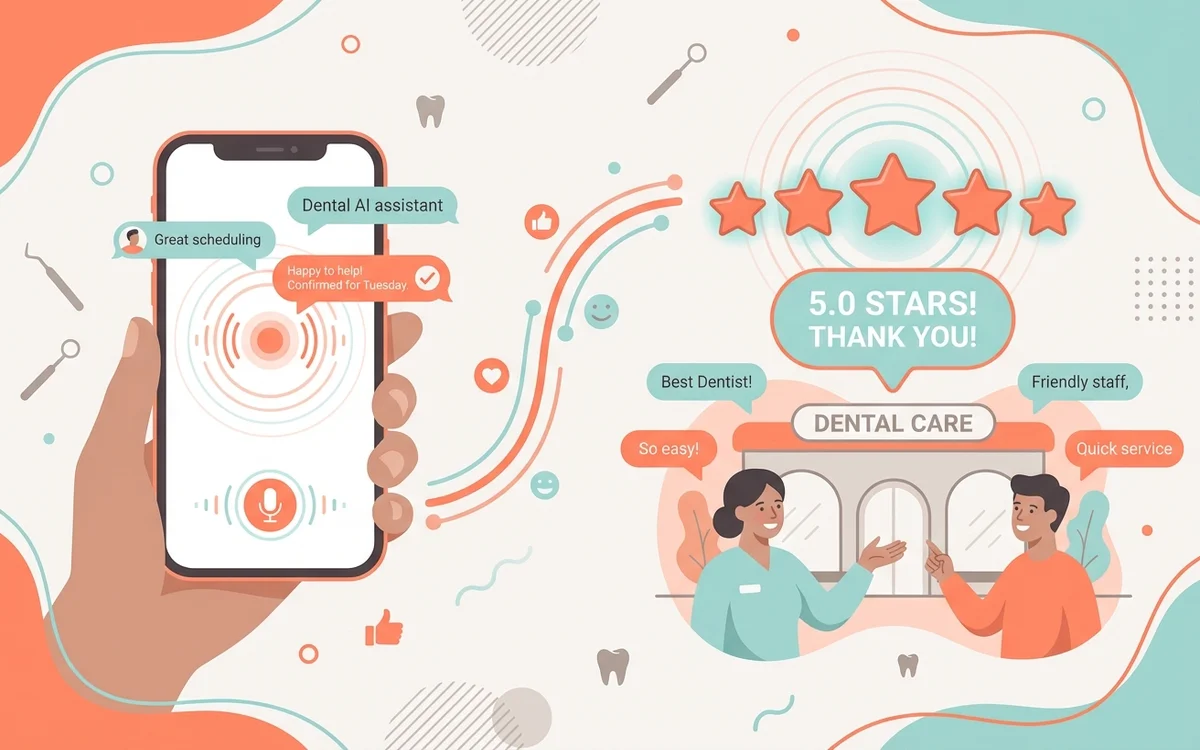
Online reviews control new patient acquisition in dentistry more than any other single factor. A BrightLocal study found that 87% of consumers read online reviews for local businesses, and dental practices are among the most review-sensitive categories — patients choosing a new dentist rely on Google and Yelp reviews as their primary decision tool.
The practices with the most 5-star reviews win more new patients. The practices with complaints about phone experience lose them before they ever sit in a chair.
What’s less obvious is how directly the phone experience drives review sentiment. Patients don’t separate their clinical experience from their communication experience when writing a review. A great cleaning followed by three failed attempts to reschedule generates a 3-star review, not a 5-star one.
This is where AI answering changes the reputation equation.
The Phone Experience Drives Reviews More Than You Think
Dental review analysis consistently shows that communication and accessibility complaints are the second most common category of negative reviews — behind only clinical outcomes. Common phrasing:
- “Could never get through on the phone”
- “Left two voicemails and never got a callback”
- “Was put on hold for 15 minutes”
- “Tried to reschedule and couldn’t reach anyone”
- “Great dentist but the front office is impossible to deal with”
Each of these complaints describes a phone experience failure. The clinical care might have been excellent — but the overall experience was dragged down by communication friction.
One negative review mentioning phone accessibility issues is visible to every prospective patient who researches your practice. It affects their decision before they ever interact with you.
How AI Answering Creates Review-Worthy Experiences
The connection between AI answering and better reviews isn’t abstract. It’s specific and measurable.
Instant Response = Positive First Impression
A patient’s first phone interaction with your practice sets the tone for the entire relationship. When that interaction is an immediate, helpful response — rather than voicemail or a long hold — the patient starts the relationship with a positive impression.
That positive impression carries forward through the clinical visit and influences the review they write afterward. The patient who was answered instantly, booked easily, and received a confirmation feels taken care of from the beginning.
No More “I Can’t Reach Your Office”
GetHelpdesk.AI answers every call — after hours, during peak periods, on closed days. The specific complaint pattern of “couldn’t get through” or “left a voicemail and never heard back” disappears completely.
This doesn’t just prevent negative reviews — it eliminates the most common communication complaint in dental reviews entirely. For practices with existing negative reviews mentioning accessibility, deploying AI answering begins reversing that pattern immediately.
Consistent Experience Across All Interactions
Review sentiment reflects the totality of a patient’s interactions, not just their best or worst one. A patient who had one great call and two frustrating calls remembers the frustrating ones.
AI answering ensures every phone interaction meets the same standard — consistent information, consistent responsiveness, consistent professionalism. The 4:45 PM Friday call is identical in quality to the 9:00 AM Tuesday call.
Post-Appointment Follow-Through
Patients who need to reschedule, have a post-treatment question, or want to book a follow-up appointment after a visit have a smooth experience through AI answering. This post-treatment communication is often where practices stumble — the initial visit goes well, but the follow-up experience is disjointed.
AI handles post-appointment scheduling with the same quality as initial booking, completing the positive experience loop that generates good reviews.
The Negative Review Prevention Effect
Preventing negative reviews has a larger impact than generating positive ones. One negative review requires approximately 10-12 positive reviews to offset in terms of overall rating impact and prospective patient perception.
The phone experience is the most preventable source of negative dental reviews because it’s the most controllable. Clinical outcomes have inherent variability. Communication quality doesn’t need to — not with AI answering handling the consistency.
Common Negative Review Triggers That AI Eliminates
- Voicemail black hole: Patient leaves message, never hears back → 1-star review mentioning “no one called me back”
- Excessive hold times: Patient waits 5+ minutes on hold → negative mention in otherwise positive review
- Rude or rushed interactions: Front desk staff stressed by volume gives short answers → patient feels disrespected
- Scheduling errors: Wrong appointment type or time booked during a rushed call → patient arrives for wrong appointment
- Can’t reach practice: Multiple call attempts go unanswered → patient gives up and writes about the experience
Each of these is a direct consequence of phone volume exceeding front desk capacity. AI answering addresses the root cause — volume management — rather than the symptoms.
The Review Generation Opportunity
Beyond preventing negative reviews, practices using AI answering are better positioned to generate positive ones.
Patients who have a seamless booking experience, receive their appointment confirmation immediately, and arrive at a practice that’s expecting them are in a positive emotional state. They’re more likely to leave a review, and that review is more likely to be positive.
Some practices combine AI answering with post-visit review requests — a text or email asking for a Google review, sent after the appointment. The conversion rate on these requests is significantly higher when the entire experience — from first call to check-out — was smooth.
Multi-Location Reputation Consistency
For practices operating across multiple locations, review management is a location-by-location challenge. One location might have great front desk coverage while another struggles with turnover and missed calls.
AI answering normalizes the phone experience across all locations. Every location has the same after-hours coverage, the same information accuracy, and the same booking quality. This means review profiles trend positively across all locations rather than varying based on staffing.
Key Takeaways
- Phone experience is the second most common category of negative dental reviews, behind only clinical outcomes
- “Couldn’t reach your office” and “never got a callback” are review-killers that AI answering eliminates completely
- Consistent phone quality across all calls — every hour, every day — prevents the inconsistency that generates negative reviews
- Preventing one negative review has more rating impact than generating 10 positive ones
- Practices with smooth end-to-end experiences (first call through follow-up) generate more and better reviews
Frequently Asked Questions
How much do online reviews actually affect new patient acquisition? Significantly. Studies show that 72% of patients use online reviews as the first step in finding a new dentist. A practice with a 4.8-star rating will attract measurably more new patients than one with 4.2 stars — even if they’re in the same area with similar services.
Can AI answering directly ask patients for reviews? GetHelpdesk.AI is focused on the phone experience — answering calls, booking appointments, and resolving patient needs. Review requests are typically handled through separate post-visit communication workflows. However, the positive phone experience AI creates is the foundation that makes review requests effective.
How quickly does better phone coverage affect review ratings? The impact begins with the first patient interaction handled by AI. However, review ratings are cumulative — meaningful changes to your overall star rating typically show over 2-3 months as new positive reviews accumulate and negative phone-related reviews stop appearing.
What about existing negative reviews mentioning phone issues? Existing reviews can’t be removed, but they become less visible as newer positive reviews push them down. More importantly, when prospective patients see recent reviews praising responsiveness alongside older reviews complaining about it, they see a practice that improved — which is actually a positive signal.
Do patients leave reviews about AI interactions specifically? Patients don’t typically identify the phone interaction as AI. They review their overall experience. When the phone experience was smooth and the clinical care was good, the review reflects both.
Your reviews tell the story of every patient experience — including the phone call. Book a demo to make sure that story is a good one.
Related Posts
10 Signs Your Dental Practice Needs an AI Answering Service
Not sure if AI answering is right for your practice? These 10 signals — from missed calls to Monday morning voicemail backlogs — tell you the answer.
AI 101 for Dentists: A Plain-Language Guide to What It Is and What It Does
Artificial intelligence sounds complicated until you see what it actually does at a dental practice. This guide explains the concepts that matter — and skips the ones that don't.
AI Answering Service for Dental Practices: The Complete Guide
Everything dental practice owners need to know about AI answering services — how they work, what they cost, what to look for, and how they compare to traditional solutions.