
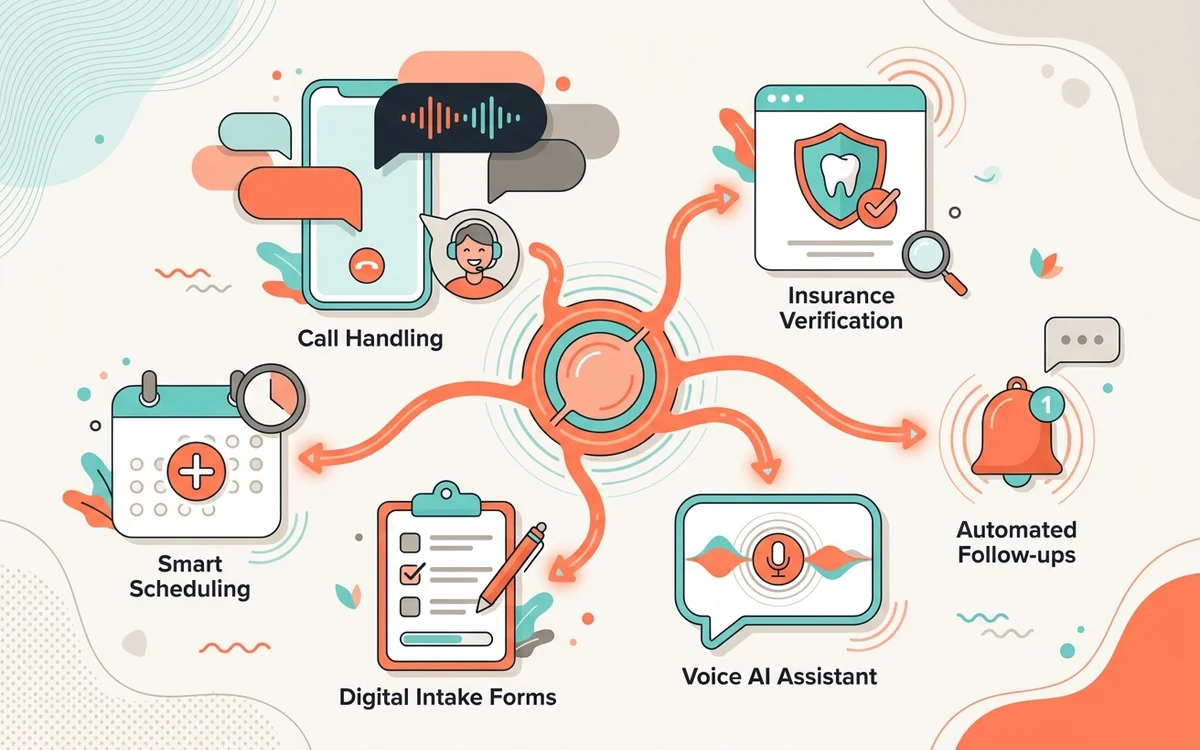
When dental practices start evaluating AI answering services, they usually ask the same questions: Does it answer calls 24/7? Can it take a message? Does it integrate with our scheduling software?
These are the wrong questions — or at least, they’re not the most important ones.
The questions that matter are: Does it book appointments directly into your PMS, or just take a message and hope someone follows up? Does it understand your scheduling rules, or does it dump every caller into the next open slot? Does it handle multi-step conversations, or fall apart the moment a patient asks something unexpected?
The difference between an AI answering service that transforms your practice and one that creates more work isn’t the marketing — it’s the features underneath. Here’s what actually matters.
Direct PMS Integration: The Line That Separates Real Systems from Message-Takers
The single most important feature to evaluate is whether the AI books appointments directly into your practice management system — or just collects information for someone to act on later.
This distinction sounds minor. It isn’t.
An AI that takes a message requires a human to follow up, make a call-back attempt, play phone tag, and eventually get the booking done. That process introduces delay, and delay kills conversions. A patient who called at 8 PM on a Wednesday and hasn’t heard back by Thursday afternoon may have already booked somewhere else.
An AI that books directly into your PMS — reading real-time availability, applying your scheduling rules, confirming the appointment before the call ends — compresses that entire process into a single conversation. The appointment exists in your calendar before the patient hangs up.
GetHelpdesk.AI integrates directly with OpenDental, Dentrix, Eaglesoft, and iDentalSoft, booking into the same calendar your team uses. That’s not a feature differentiator — it’s the foundation everything else builds on.
Scheduling Intelligence: Rules, Not Just Slots
A PMS integration alone isn’t enough if the AI doesn’t understand how your practice schedules.
Every dental practice has scheduling logic that isn’t written down anywhere — it’s just how things work. New patient exams go with certain providers. Hygiene patients go in specific rooms. Emergencies get flagged differently than routine care. Block times exist for procedure-heavy afternoons.
A basic scheduling AI ignores this context. It finds an open slot and books it. The result: appointments in the wrong rooms, with the wrong providers, at times that disrupt your clinical flow.
A sophisticated scheduling AI understands appointment types, duration requirements, provider preferences, operatory assignments, and business rules. It books the right appointment — not just any appointment.
This is what GetHelpdesk.AI means by intelligent scheduling: the AI is configured with your practice’s specific logic, so the appointment it books is one your team would have booked the same way.
24/7 Coverage Without the Overhead
The math on after-hours calls is straightforward: practices that are closed 12-16 hours a day are unreachable for the majority of the day. Patients call when they have time — evenings, weekends, lunch breaks — and get voicemail.
Most don’t call back.
A 24/7 AI answering service captures that demand. But the coverage needs to be genuinely effective — not just “someone answered” but “someone answered, understood what the patient needed, and booked them appropriately.”
This requires the AI to handle the full range of call types that come in after hours:
- New patient appointment requests
- Existing patient reschedules
- After-hours emergency triage
- General information (hours, insurance, location)
- Calls in multiple languages
GetHelpdesk.AI handles 25+ languages automatically, adapting to the caller without configuration changes. For practices in multilingual markets, this alone changes after-hours call outcomes dramatically.
Emergency Call Handling and Triage
Not every after-hours call is a routine booking request. Patients call with broken teeth, post-extraction pain, lost restorations, and genuine dental emergencies.
An AI answering service needs a clear protocol for these situations — one that’s configured to match your practice’s actual emergency procedures. The right system:
- Identifies emergency signals in the conversation
- Collects enough information to understand urgency
- Routes appropriately — on-call provider notification, emergency line escalation, or next-day priority booking
- Never leaves a patient in genuine distress with an inadequate response
This is a feature to ask about specifically when evaluating vendors. Generic AI systems often handle emergencies poorly. Purpose-built dental AI should handle them with a defined, configurable protocol.
Multi-Language Support
The demographics of dental patients in most US markets are diverse. A practice in Austin, Miami, Los Angeles, or Chicago serves patients who are more comfortable in Spanish, Vietnamese, Portuguese, or Mandarin than in English.
When an AI answering service can only respond in English, a significant portion of your patient population gets a worse experience — or no experience at all. They don’t book. They call a practice that speaks their language.
Multi-language support should be automatic — the AI detects the caller’s language from the conversation and responds accordingly. No special setup, no “press 2 for Spanish” routing.
Call Transcripts and Analytics
Every call handled by an AI answering service is a data point. Practices that access that data learn things about their patient population they didn’t know from manual call handling.
Which appointment types are most commonly requested? What time of day do new patient calls peak? How many calls are emergency-related? What questions do callers ask most often that suggest a gap in your website information?
A good AI answering service surfaces this through call transcripts, call recordings, and analytics dashboards. Your front desk can review what happened on any call. Your practice manager can identify trends across hundreds of calls per month.
This visibility doesn’t just help you improve the AI — it helps you improve your practice communication and marketing.
What to Avoid: Common Gaps in AI Answering Services
Not all systems marketed as “AI dental answering services” deliver on the fundamentals. Watch for:
- Message-only systems that collect contact info but can’t book — you still have all the follow-up work
- Generic chatbots trained on dental content but not your specific practice data — they give wrong information about your hours, providers, and services
- Rigid scripts that break when patients say something unexpected — real conversations don’t follow scripts
- Per-minute pricing that makes you hesitant about the AI taking its time to do the conversation right
Key Takeaways
- Direct PMS booking is the feature that separates true AI receptionist systems from message-taking services
- Scheduling intelligence — understanding your rules, not just your open slots — is what makes booked appointments actually usable
- 24/7 coverage only delivers full value when the AI can handle every call type effectively, including emergencies
- Multi-language support expands your accessible patient pool without extra setup
- Call transcripts and analytics turn every AI interaction into practice intelligence
- Per-call or per-minute pricing creates the wrong incentives — flat monthly subscriptions align AI performance with practice goals
Frequently Asked Questions
What’s the difference between an AI answering service and a traditional answering service? Traditional answering services use human operators who take messages and forward them to your office. AI answering services can have full conversations, answer practice-specific questions, and — if properly integrated — book appointments directly into your PMS without any human follow-up.
Can an AI answering service really replace my front desk? It’s not designed to replace your front desk — it’s designed to handle the calls your front desk can’t. After-hours calls, overflow during busy periods, and closed-day coverage. Your team focuses on in-office patients; the AI handles the phones.
How long does it take to set up an AI answering service for a dental practice? GetHelpdesk.AI typically requires a single onboarding call with the founder to configure your practice-specific information. Most practices are live within a week. The setup involves configuring your scheduling rules, appointment types, provider preferences, and practice information.
What happens if a patient asks something the AI doesn’t know? The AI is configured to handle out-of-scope questions gracefully — either by directing the patient to call back during business hours for team assistance, or by flagging for a follow-up. It doesn’t guess or make up information.
Is AI answering HIPAA compliant? GetHelpdesk.AI is fully HIPAA compliant. Patient data is encrypted, stored securely, and handled according to healthcare data protection requirements.
Seeing these features in action is more useful than reading about them. Book a 9-minute demo to see GetHelpdesk.AI handle a live call for your practice type.
Related Posts
10 Signs Your Dental Practice Needs an AI Answering Service
Not sure if AI answering is right for your practice? These 10 signals — from missed calls to Monday morning voicemail backlogs — tell you the answer.
AI 101 for Dentists: A Plain-Language Guide to What It Is and What It Does
Artificial intelligence sounds complicated until you see what it actually does at a dental practice. This guide explains the concepts that matter — and skips the ones that don't.
AI Answering Service for Dental Practices: The Complete Guide
Everything dental practice owners need to know about AI answering services — how they work, what they cost, what to look for, and how they compare to traditional solutions.